End suction pump manufacturer
We manufacture end suction pumps for water transfer, HVAC circulation, irrigation, pressure boosting, and general industrial fluid handling. Our factory helps buyers match casing structure, impeller diameter, motor power, seal configuration, and connection standard to required flow, head, installation layout, and working medium.
End Suction Pump Advantages
Standardized Pump Structure
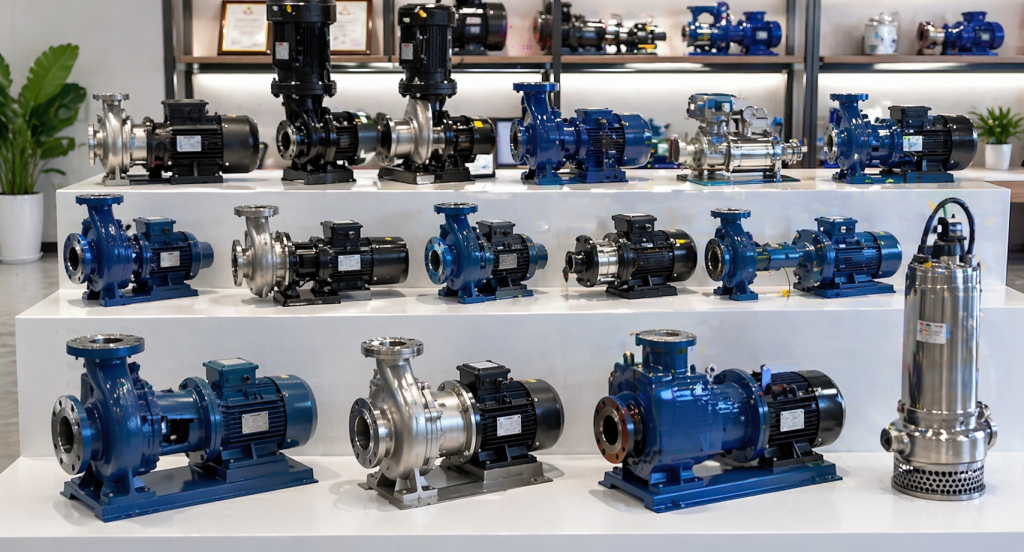
Most end suction centrifugal pumps use a horizontal structure with axial suction and radial discharge. This layout supports easier pipeline arrangement, motor access, coupling inspection, and routine maintenance compared with compact sealed pump structures.
Clear Hydraulic Matching
End suction pumps must be selected according to flow rate, total head, suction condition, and pipe resistance. We review the duty point before model selection to reduce oversizing, low efficiency operation, unstable discharge pressure, or unnecessary motor cost.
Impeller Diameter Control
Impeller diameter affects head, flow capacity, motor load, and operating point. During selection, we check whether the requested performance can be achieved through standard impeller sizing or whether trimming is required within the available pump series.
Seal and Bearing Selection
Mechanical seal, bearing type, shaft material, and wear area should match liquid temperature, water quality, and running time. Proper component selection helps reduce leakage, shaft vibration, bearing wear, and unplanned maintenance in continuous operation systems.
Custom End Suction Pumps
Close-Coupled End Suction Pumps
Close-coupled end suction pumps connect the pump body directly to the motor, reducing footprint and simplifying installation. Selection focuses on flow rate, head, motor power, casing material, seal type, and inlet/outlet connection.
Long-Coupled End Suction Pumps
Long-coupled end suction pumps use a separate motor, coupling, baseplate, and pump unit. Technical selection includes coupling alignment, baseplate rigidity, bearing support, shaft design, and maintenance space around the assembly.
Cast Iron Water Pumps
Cast iron end suction pumps are commonly used for clean water, HVAC water, cooling water, irrigation, and general industrial transfer. We select casing thickness, impeller material, shaft seal, and motor power based on water quality and operating duty.
Stainless Steel End Suction Pumps
Stainless steel end suction pumps are used where corrosion resistance or cleaner liquid contact is required. Selection focuses on stainless steel grade, impeller material, sealing components, connection type, and working temperature.
Diesel Engine Driven Pumps
Diesel engine driven end suction pumps are used for irrigation, emergency drainage, construction dewatering, and areas without stable electric power. Selection depends on engine power, fuel consumption range, pump curve, coupling method, base frame, and site mobility.
OEM Pump Packages
For distributors, importers, and equipment builders, we support OEM end suction pump projects with logo, nameplate, paint color, packaging, motor configuration, connection standard, and selected structural adjustments. Technical confirmation can be based on drawings, samples, pump curves, or existing model numbers.
End Suction Pump Specifications
| Projects | Content |
|---|---|
| Product Type | Close-coupled, long-coupled, cast iron, stainless steel, diesel-driven end suction pump |
| Flow Range | Commonly from several m³/h to hundreds of m³/h depending on pump model |
| Head Range | Low, medium, and high head options based on impeller diameter and motor power |
| Pump Structure | Horizontal single-stage centrifugal pump with axial suction and radial discharge |
| Casing Material | Cast iron, stainless steel, bronze, or other material depending on liquid condition |
| Impeller Options | Cast iron, stainless steel, brass, bronze, or engineered material by application |
| Seal Type | Mechanical seal with elastomer and sealing face selected by fluid and temperature |
| Connection Standard | Threaded or flanged connection depending on model size and buyer requirement |
End Suction Pump Applications
HVAC Water Circulation
Industrial Water Transfer
Building Pressure Boosting
COMMON QUESTIONS
End Suction Pump Manufacturer FAQs
How do I choose an end suction pump manufacturer for OEM orders?
When choosing an end suction pump manufacturer for OEM orders, buyers should check pump curve availability, material options, motor configuration, casting control, seal selection, assembly process, packaging capability, and export experience. Logo, nameplate, paint color, and packaging requirements should be confirmed before pricing.
What information is needed before sourcing end suction centrifugal pumps?
Before sourcing end suction centrifugal pumps, we usually need flow rate, head, liquid type, temperature, voltage, frequency, inlet and outlet size, installation layout, and running hours. For replacement projects, photos of the old pump nameplate and system connection can help with model matching.
Can your factory customize horizontal end suction pumps?
Yes, our factory can customize selected horizontal end suction pumps with logo, paint color, motor voltage, frequency, casing material, impeller material, seal configuration, connection standard, and packaging. Structural customization depends on MOQ, existing pump platform, mold availability, and testing requirements.
What affects end suction pump lead time?
Lead time depends on pump model, casing material, motor availability, impeller configuration, order quantity, paint requirement, packaging design, and inspection scope. Standard cast iron models are usually easier to prepare, while stainless steel, diesel-driven, or private-label configurations may require longer production time.
Are end suction water pumps suitable for corrosive liquids?
End suction water pumps can be used for some mildly corrosive liquids if the casing, impeller, shaft, mechanical seal, and elastomer materials are properly selected. Buyers should provide liquid composition, concentration, temperature, and operating conditions before final selection.
Get a Professional Quote
Tell us your requirements and get a response within 12 hours.