A vertical inline pump cannot safely run dry. When liquid flow stops and the pump continues to operate, the mechanical seal loses lubrication, bearings overheat, and the impeller can seize within seconds to minutes depending on pump size and speed. The damage is often immediate and requires seal replacement, bearing replacement, or complete pump refurbishment. This matters in HVAC systems, fire standby installations, booster sets, and any recirculating application where supply interruption, valve closure, or low tank level can starve the pump.
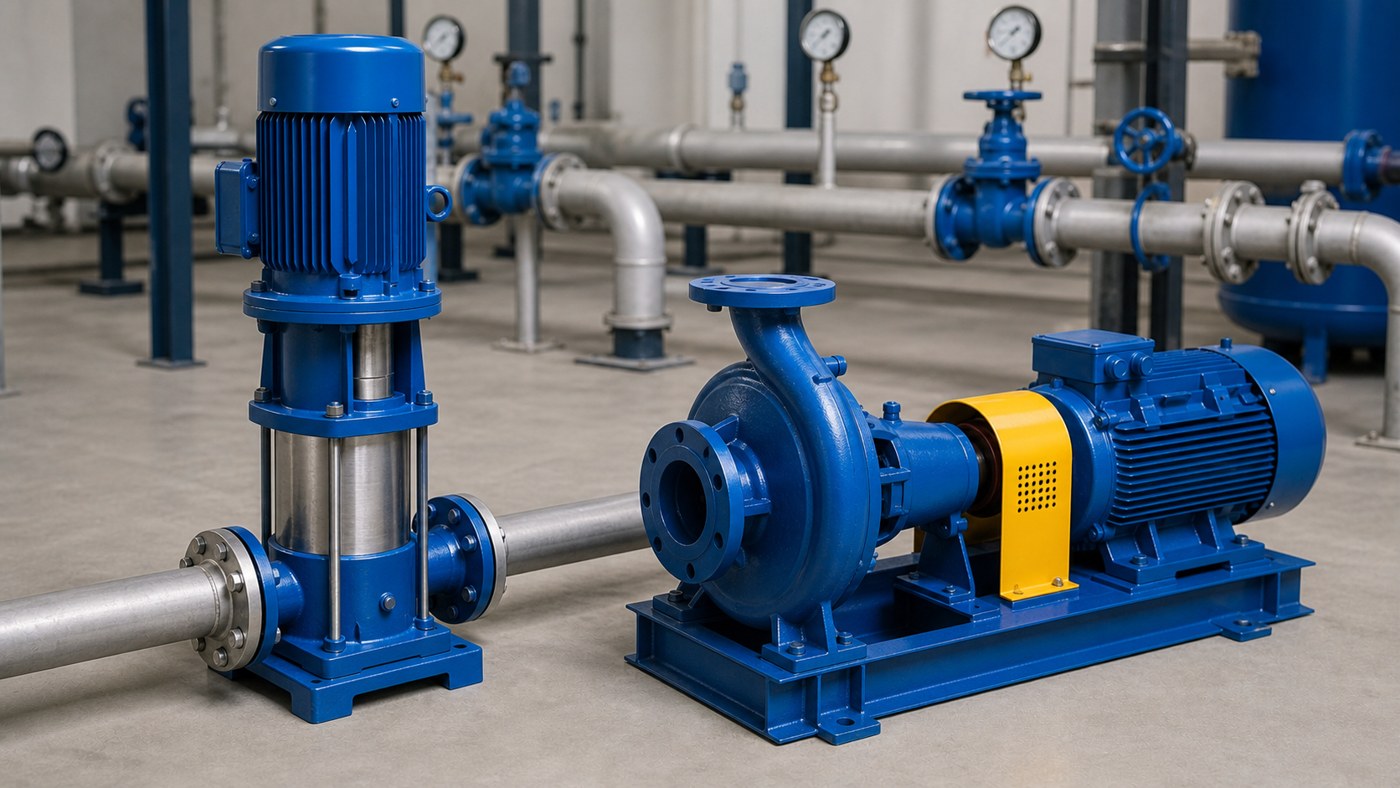
The practical question is not whether dry running is safe—it is not—but how to prevent it through system design, controls, and operating procedures. This guide covers the damage mechanism, the protection methods that work in real installations, and the field checks that separate reliable systems from frequent failure calls.
Key Takeaways
- Dry running destroys mechanical seals and bearings in under two minutes for most vertical inline pumps; prevention is mandatory, not optional.
- Flow switches, pressure sensors, and minimum-level controls must be matched to pump response time and fail-safe wiring.
- Fire pump installations follow NFPA 20 requirements that prohibit automatic low-level shutoff; understand the difference before specifying controls.
- Suction lift, air pockets, and inadequate submergence cause intermittent dry conditions that standard controls may not catch.
- Quotations and service requests should include liquid source, suction arrangement, control strategy, and failure consequence—not only flow and head.
Why Vertical Inline Pumps Fail During Dry Running
Vertical inline pumps rely on the pumped liquid to cool the motor cavity, lubricate the mechanical seal faces, and support hydrodynamic bearing operation. When liquid flow stops, three failure modes activate simultaneously.
First, the mechanical seal loses its liquid film. Seal faces are machined to tight tolerances and rely on a thin layer of liquid to prevent metal-to-metal contact. Without liquid, friction generates heat that warps the faces, damages the secondary seals, and allows leakage even after liquid returns.
Second, bearings lose cooling. Most vertical inline pumps use ball or sleeve bearings that depend on liquid circulation to carry away frictional heat. Without cooling, bearing grease breaks down, metal expands, and clearances close until the bearing locks or the shaft galls.
Third, the impeller may contact the volute or wear rings as thermal expansion exceeds design clearances. This produces noise, vibration, and scoring that degrades efficiency even if the pump restarts.
The time to failure depends on pump speed, seal type, bearing design, and residual liquid in the casing. Small pumps operating at 3500 RPM may fail in under 60 seconds. Larger pumps at 1750 RPM may survive two to three minutes. No standard vertical inline pump is rated for continuous dry operation.
Protection Methods That Work in the Field
Effective dry-run protection requires both hardware and control logic. A single sensor is rarely sufficient because sensors can fail, installations can introduce air pockets, and transient conditions can fool simple threshold detection.
Flow Switches and Paddle Sensors
Flow switches mounted downstream detect loss of flow and cut power to the motor. Paddle-type switches respond in one to three seconds and work well in clean water systems. Thermal dispersion or ultrasonic flow sensors handle solids better but cost more and require calibration to the specific liquid and pipe size.
The switch must be wired to interrupt the motor starter, not just trigger an alarm. Delayed restart logic should prevent immediate re-energization, which can cycle the pump on and off and cause repeated seal damage.
Pressure Sensors and Minimum-Pressure Cutoff
A pressure transducer on the discharge can detect loss of developed head. Set the cutoff threshold above the system static pressure but below the normal operating pressure. This method works for both recirculating and transfer applications.
Pressure-based protection responds faster than flow switches but can be defeated by check valve leakage or closed discharge valves. Use both pressure and flow sensing in critical applications.
Level Controls and Suction Tank Interlocks
For pumps drawing from tanks, sumps, or reservoirs, a low-level switch in the suction vessel should inhibit pump start and stop a running pump before the liquid surface drops below the minimum submergence depth.
Submergence depth must account for vortex formation and air entrainment, not only net positive suction head available. A common mistake is setting the minimum level at the pipe inlet centerline. The correct level is typically one to two pipe diameters above the inlet, depending on flow velocity and tank geometry.
Pilot Duty and Aquastat Protection
In HVAC systems, a temperature sensor can detect overheating before seal failure. This is a backup method, not a primary control, because the pump may already be damaged by the time the temperature rises enough to trigger the cutoff.
Special Considerations for Fire Pump Installations
Fire pumps follow different rules. NFPA 20 prohibits automatic shutdown based on low suction pressure or tank level because the fire pump must continue to operate during an emergency even if doing so damages the pump. The priority is fire suppression, not equipment protection.
Fire pump controllers include low-suction-pressure alarms but do not stop the pump. The pump will run dry if the water supply is exhausted, and it will be rebuilt or replaced after the event. This is intentional and must not be bypassed by adding automatic dry-run protection.
If you are specifying a vertical inline pump for fire service, confirm that the controller complies with NFPA 20 and that the maintenance staff understands the pump will sacrifice itself to maintain flow. This is not a design flaw; it is a life-safety requirement.
Field Checks Before Startup or After Service
Before energizing a vertical inline pump, verify the following conditions to prevent immediate dry-run damage.
- Confirm liquid is present in the suction line and the pump casing is vented or filled through the vent plug.
- Check that all suction and discharge valves are open and control valves are in the correct position.
- Verify rotation direction by bumping the motor starter and observing the shaft rotation through the coupling guard.
- Test the dry-run protection by simulating low flow or low level and confirming the pump stops within the design time.
- Record baseline pressure, flow, and amperage so future readings can be compared.
If the pump has been idle for more than a few weeks, manually rotate the shaft before startup to confirm the bearings and seal have not seized. This is especially important in applications with suspended solids or crystallizing liquids.
When to Upgrade Protection or Replace the Pump
If a vertical inline pump has experienced repeated dry-run failures, the root cause is usually system design or control logic, not the pump itself. Adding more sensitive protection may help, but the better solution is often to eliminate the condition that starves the pump.
Common system fixes include increasing suction tank volume, adding a bypass line to maintain minimum flow, relocating the pump to reduce suction lift, or installing a variable frequency drive to reduce flow during low-demand periods. Each option has cost and complexity tradeoffs that depend on the specific application.
Replacing a failed pump with the same model without fixing the system will result in the same failure. Document the operating conditions, control settings, and failure mode before ordering a replacement so the underlying problem can be addressed.
Frequently Asked Questions
Can a vertical inline pump recover after running dry for a few seconds?
Sometimes, but not reliably. A brief dry run may not cause immediate catastrophic failure, but it degrades seal faces and bearing surfaces. The pump may restart and appear normal but fail weeks later under full load. If dry running occurs, inspect the seal and bearings during the next maintenance cycle.
What happens if I restart a pump immediately after a dry-run trip?
The seal faces may still be hot and distorted. Restarting too soon can complete the damage that the protection system tried to prevent. Program a minimum lockout time of 30 to 60 seconds, and require manual reset if the pump tripped on dry-run protection.
Do magnetic drive or canned motor pumps survive dry running better than seal pumps?
Magnetic drive pumps eliminate the mechanical seal but still rely on liquid cooling for the bearings and the magnetic coupling. They fail differently—often with demagnetization or bearing seizure—but they do not survive dry running. Canned motor pumps are slightly more tolerant because the rotor and stator are cooled by the pumped liquid, but they are not rated for dry operation.
Should I install a recirculation line to prevent dry running?
A recirculation line can maintain minimum flow during low-demand periods, but it does not prevent dry running if the liquid source is lost. Use recirculation to protect against low-flow damage, and use level or pressure controls to protect against dry running. They solve different problems.
Can I use a vertical inline pump in a suction lift application?
Yes, if the pump is self-priming or if the suction line is primed manually and remains full. Standard vertical inline pumps are not self-priming and will run dry if the suction line loses its prime. For suction lift, specify a self-priming pump or install a foot valve and priming system.
What should I send a supplier when requesting a replacement after dry-run failure?
Send the nameplate photo, pump curve if available, photos of the installation and damage, description of what happened before the failure, and any control or alarm settings. Also describe what has been changed since the original installation—piping, valves, liquid source, or operating schedule—so the replacement can be verified against current conditions, not original design.
Conclusion
A vertical inline pump cannot run dry without damage. The practical decision is not whether to allow dry running but how to prevent it through reliable controls, proper suction arrangement, and fail-safe logic. Match the protection method to the application: flow switches for clean-water systems, pressure sensors for transfer duty, level controls for tank suction, and combined protection for critical or unattended installations. If a pump has failed due to dry running, fix the system condition before replacing the pump, or the replacement will fail the same way. For fire pump service, follow NFPA 20 and accept that the pump may be sacrificed during an emergency. Document the duty, the liquid source, the control strategy, and the failure consequence so the final selection and protection design can be verified against real operating conditions.