
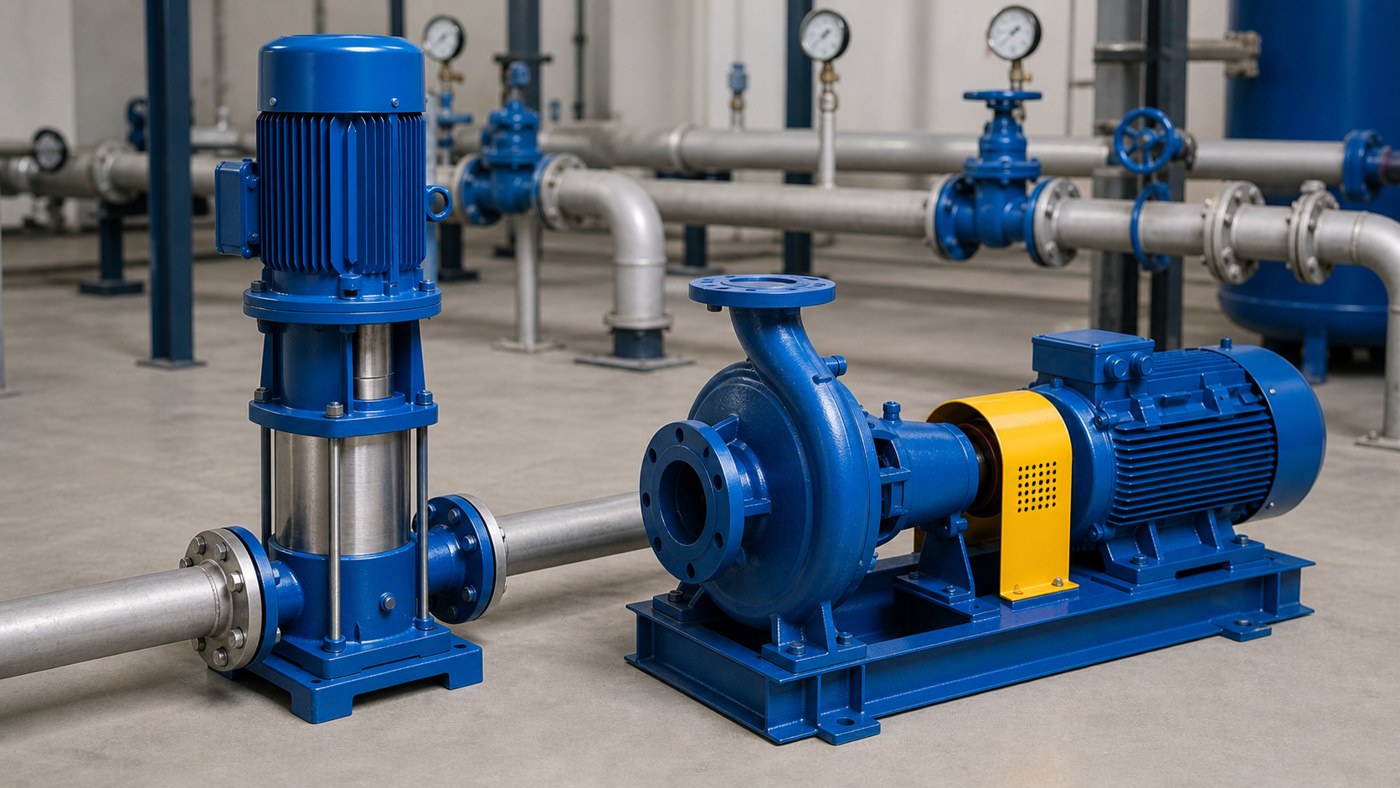
Vertical inline pumps and horizontal pumps differ primarily in footprint, serviceability, and installation constraint. Vertical inline pumps mount directly in the pipeline and save floor space, making them common in mechanical rooms, rooftop systems, and retrofit projects where access is limited. Horizontal pumps sit on a baseplate with the motor beside the pump body, offering easier maintenance access and better tolerance for heavy-duty or variable-load applications. The choice depends on available space, service frequency, medium condition, and consequence of failure.
Both pump types can deliver the same flow and head on paper, but the site decides which one works better. A clean HVAC circulator in a mechanical room has different risks than a sewage pump in a wet well or a fire pump in a critical facility. This guide explains the mechanism, the decision logic, and the field checks that make the comparison useful in real applications.
Key Takeaways
- Vertical inline pumps save floor space and install directly in the pipeline; horizontal pumps require a baseplate but offer easier bearing and seal access.
- Confirm duty point, liquid condition, NPSH available, and installation access before selecting a pump type or approving a replacement.
- Use the pump curve, motor nameplate, and field measurements together; isolated numbers rarely explain performance problems.
- For fire, sewage, well, booster, or process service, verify control logic, redundancy, and failure consequence before finalizing the design.
- A complete quotation should include flow, total dynamic head, liquid type, temperature, voltage, pipe size, installation position, and photos or drawings when available.
How Each Pump Type Works
A vertical inline pump uses a shaft-mounted impeller inside a volute casing that connects directly to the pipeline flanges. The motor mounts above the pump body on a bracket or support frame. The shaft passes through a mechanical seal or packing gland, and the thrust bearing carries the axial load from the impeller. Because the pump and motor form a single vertical assembly, the footprint is compact and the pump can be installed without a separate baseplate.
A horizontal pump places the impeller and volute on a horizontal shaft supported by bearings in the pump body. The motor sits beside the pump on a common baseplate, connected by a flexible coupling. Maintenance access is better because you can remove the motor, coupling, or pump end without lifting the entire unit. Horizontal pumps handle higher flows, higher heads, and more demanding service conditions more easily than most vertical inline designs.
The key difference is not the impeller design or the hydraulic performance. It is the mechanical arrangement, service access, and installation constraint.
When Each Pump Type Wins
| Factor | Vertical Inline Pump | Horizontal Pump |
|---|---|---|
| Floor space | Minimal footprint, fits tight mechanical rooms and rooftops | Requires baseplate and service clearance around motor and coupling |
| Installation | Mounts directly in pipeline, no alignment between pump and motor | Needs baseplate, grouting, and coupling alignment |
| Maintenance access | Must lift motor or entire assembly to reach seal and bearings | Motor, coupling, and pump end accessible without lifting |
| Service frequency | Best for clean liquids and long service intervals | Better for frequent seal or bearing replacement |
| Heavy-duty or high-head applications | Limited by shaft rigidity and bearing design | Handles higher loads, higher speeds, and multistage designs |
| Suction conditions | Sensitive to air entrainment and low NPSH available | More forgiving with poor suction conditions or lift |
| Vibration and noise | Lower mass, more sensitive to pipe strain and misalignment | Heavier baseplate absorbs vibration better |
In practice, vertical inline pumps dominate HVAC circulation, pressure boosting in buildings, and retrofit projects where space is limited. Horizontal pumps are more common in industrial plants, wastewater facilities, irrigation systems, and fire pump rooms where service access and reliability matter more than footprint.
Field Selection Criteria
Before choosing a pump type, confirm the duty point and operating conditions. The duty point includes flow rate and total dynamic head. Operating conditions include liquid type, temperature, solids content, viscosity, suction arrangement, and control method. A pump that works well in one application may fail quickly in another, even if the flow and head are identical.
Check the consequence of failure. If pump failure only reduces comfort or delays a non-critical process, a compact and cost-effective vertical inline pump may be acceptable. If failure stops production, damages equipment, floods a space, or compromises fire protection, choose the pump type with better redundancy, easier service access, and clearer documentation. In critical applications, the ability to replace a seal or bearing in 30 minutes instead of three hours can justify the larger footprint of a horizontal pump.
Verify the suction conditions. Vertical inline pumps are more sensitive to cavitation, air leaks, and insufficient submergence. If the pump must lift water from a tank or well, or if the suction line is long or has multiple fittings, check the net positive suction head available and compare it to the pump’s NPSH required. Horizontal pumps tolerate poor suction conditions better because the shaft and bearing arrangement is more stable.
Consider the control logic. A pump that starts and stops frequently, cycles on pressure, or runs under VFD control needs better motor thermal protection and more robust bearings. If the pump is part of a fire system, the controller, jockey pump, and pressure switch settings must match the authority-approved design. Do not substitute a pump type without verifying that the control logic still works correctly.
Common Mistakes to Avoid
- Selecting a pump based only on flow and head without checking liquid condition, suction arrangement, or control method.
- Choosing a vertical inline pump for an application that requires frequent seal or bearing replacement, then discovering that service takes three times longer than expected.
- Ignoring pipe strain. Vertical inline pumps are lighter and more sensitive to misaligned or stressed piping. If the flanges are out of alignment or the pipe hangers are missing, the pump will vibrate or fail early.
- Replacing a horizontal pump with a vertical inline pump to save space without checking whether the system NPSH available is adequate for the new pump design.
- Treating a fire pump or sewage pump like a standard clean-water circulator. These applications have specific material, seal, and control requirements that are not obvious from the flow and head alone.
- Assuming the replacement pump is correct because the pipe connection size matches. Connection size does not confirm duty point, motor size, or seal type.
What to Send Before Quotation or Technical Review
A complete pump request should include the expected flow rate, total dynamic head or discharge pressure target, liquid type, temperature, solids content if any, site voltage and phase, installation position, and daily operating hours. For replacement projects, add photos of the existing pump nameplate, motor nameplate, pipeline arrangement, control panel, and any visible problem such as leaks, corrosion, or vibration damage.
If the pump operates in a fire system, sewage application, industrial process, or deep well, include a system drawing, control wiring diagram, and any applicable standard or authority approval. These details help the supplier confirm whether the proposed model meets the application requirements and whether the existing installation can support the new pump without modification.
FAQs
Can I replace a horizontal pump with a vertical inline pump to save space?
Only if the vertical inline pump can meet the same duty point, NPSH requirement, and service access expectation. Vertical inline pumps are lighter and more compact, but they are also more sensitive to pipe strain, suction conditions, and bearing wear. If the application requires frequent seal or bearing replacement, or if the suction lift is high, the horizontal pump may still be the better choice despite the larger footprint.
Why does a pump vibrate even when the model seems correct for the flow and head?
Vibration often comes from system conditions rather than pump selection. Common causes include pipe misalignment, missing or loose hangers, cavitation from poor suction conditions, air entrainment, wrong rotation direction, worn bearings, damaged impeller, or operation far from the best efficiency point. Check the suction pressure, discharge pressure, motor current, and shaft alignment before replacing the pump.
What documents help a supplier verify the pump selection?
A pump performance curve, motor nameplate data, installation drawing, liquid analysis or material safety data sheet, piping isometric, voltage and control wiring diagram, and operating schedule all help. For replacement projects, photos of the existing pump, motor, pipeline, and problem area are more useful than a verbal description. If a fire, sewage, or industrial standard applies, mention it before model selection begins.
Should I always replace a failed pump with the same model?
Not automatically. If the original pump was correctly selected and the system has not changed, the same model may be acceptable. But if flow, pressure, liquid condition, pipework, control logic, or operating schedule has changed, repeat the selection check. Many replacement failures happen because the new pump matches the old nameplate but not the current duty.
What happens if I install a pump designed for clean water in a sewage or slurry application?
The pump will fail quickly. Sewage and slurry applications require different impeller designs, larger clearances, abrasion-resistant materials, and more robust seals. A clean-water pump will clog, wear out, or lose efficiency within days or weeks. Always specify the liquid condition accurately, including solids content, particle size, and chemical properties.
Conclusion
The choice between a vertical inline pump and a horizontal pump depends on installation space, service access, liquid condition, suction arrangement, and failure consequence. Vertical inline pumps save floor space and simplify installation in clean-water HVAC and booster applications. Horizontal pumps offer better maintenance access, higher load capacity, and more tolerance for demanding or variable conditions. Before approving a selection or replacement, confirm the duty point, verify the suction conditions, check the control logic, and document the site constraints so the final pump matches the real application, not only the catalog specification.