
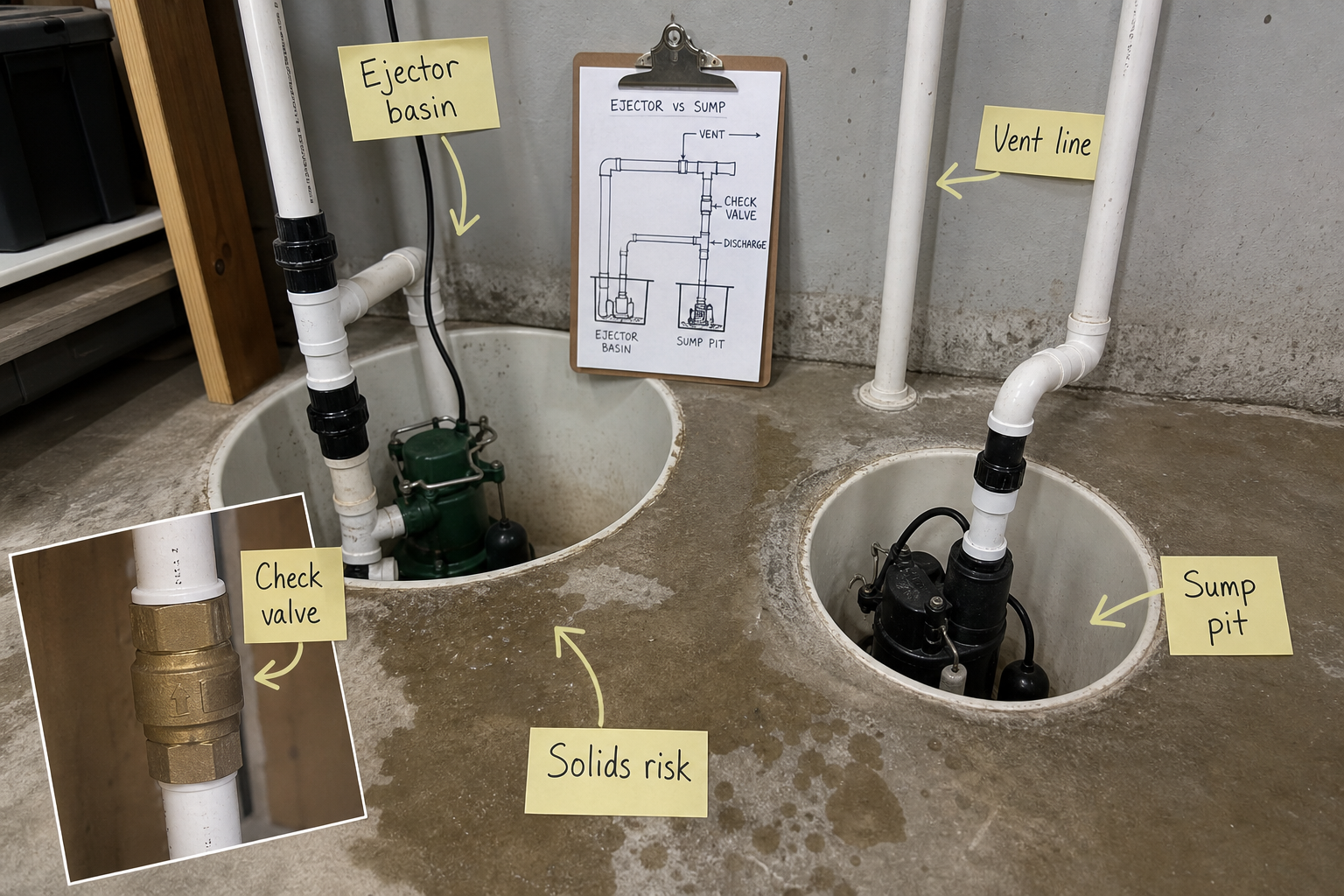
Field-style article image prepared for sewage ejector pump vs sump pump.
The fastest way to separate a sewage ejector pump from a sump pump is to look at what enters the basin. If the basin receives toilet waste, suspended solids, or wastewater from below-grade fixtures, it needs an ejector system with venting, backflow protection, and solids-handling hydraulics. If the basin collects groundwater, foundation drainage, or clear nuisance water, a sump pump is normally the correct category.
**A sewage ejector pump moves wastewater containing solids from below-grade fixtures to the building drain or sewer line, using a vortex or grinder impeller that handles 2-inch solids and operates in a sealed basin.** A sump pump removes clean groundwater or stormwater from a basement sump pit to an exterior drain, using an open impeller that handles minimal solids and operates in a vented basin. The core differences are solids capability, discharge pressure requirements, and sanitary code compliance.
The choice between sewage ejector and sump pump depends on three factors: whether the source fluid contains human waste or solid debris, whether the discharge point sits above the pump or requires lift against gravity, and whether local plumbing codes classify the application as a sanitary waste system.
Key Takeaways
- Sewage ejector pumps handle 2-inch diameter solids and operate in sealed basins below toilets, showers, or laundry fixtures that drain below the building sewer line.
- Sump pumps remove groundwater with particle sizes under 1/2 inch and discharge to daylight drains or storm sewers, not sanitary systems.
- Installation height matters: sewage ejectors typically sit 10-15 feet below grade to collect fixture drainage; sump pumps sit at the lowest basement floor point.
- Sewage ejector failure creates sanitary hazards requiring backup pumps or high-level alarms; sump pump failure causes property water damage but no health risk.
- Discharge pipe sizing differs: sewage ejectors require minimum 2-inch Schedule 40 PVC with check valve and gate valve; sump pumps use 1.5-inch to 2-inch PVC with check valve only.
Solids Handling and Impeller Design
Sewage ejector pumps use vortex impellers or grinder assemblies designed to pass 2-inch spherical solids without clogging. The vortex impeller creates a spinning flow pattern that keeps solids suspended and moves them through the volute without direct impeller contact. Grinder pumps add a cutting mechanism that reduces solids to slurry before pumping, allowing smaller discharge pipes but requiring more motor power and maintenance.
Sump pumps use open or semi-open centrifugal impellers optimized for high flow rates with low head pressure. These impellers handle sand, silt, and small debris up to 1/2 inch but clog immediately when toilet paper, sanitary products, or fibrous material enters the basin. The impeller vanes sit close to the volute wall, creating high velocity but zero tolerance for soft solids that wrap around the shaft.
A sewage ejector pump rated at 1/2 HP typically moves 50-70 gallons per minute against 15-20 feet of head. The same horsepower sump pump moves 80-100 GPM but only against 10 feet of head, because the open impeller prioritizes flow volume over pressure.
Installation Depth and Basin Requirements
Sewage ejector systems install in sealed basins 30-36 inches in diameter and 36-48 inches deep, positioned below the lowest fixture drain in the building. If a basement toilet drains at elevation -10 feet relative to the building sewer at elevation 0, the ejector basin floor must sit at -12 to -14 feet to provide drainage slope and pump submergence.
The basin requires a sealed lid with a 2-inch vent pipe that extends through the roof, maintaining neutral pressure and preventing sewer gas release into occupied spaces. The pump connects to a vertical discharge pipe with a check valve at the basin penetration and a gate valve above grade for service access.
Sump pump installations use open-top basins 18-24 inches in diameter and 24-30 inches deep, placed at the lowest slab point where groundwater collects. The basin sits on undisturbed soil or crushed stone, with perforated drain tiles feeding water from the foundation perimeter. No sealed lid is required because the fluid is non-sanitary, but a vented cover prevents debris entry and reduces humidity.
Discharge pipes for sump pumps can terminate at grade level if site slope allows gravity drainage away from the building. Sewage ejector discharge must tie into the building sanitary drain above the basement floor or route to a public sewer connection, requiring vertical lift ranging from 8 to 25 feet depending on building height and sewer depth.
Operating Cycle and Motor Duty Rating
Sewage ejector pumps operate intermittently based on fixture use, cycling 5-15 times per day in residential applications and 20-50 times per day in commercial restrooms. Each cycle runs 30-90 seconds as the basin fills from 12 inches (pump-on level) to 6 inches (pump-off level). The motor must handle frequent starts without overheating, requiring thermal overload protection and continuous-duty rating.
Sump pumps cycle based on groundwater infiltration rates and weather events. During spring thaw or heavy rain, a sump pump may run continuously for hours or cycle every 2-5 minutes for days. In dry conditions, the pump may not run for weeks. This variable duty cycle requires a motor rated for continuous operation but sized for the peak flow condition, not average load.
A sewage ejector motor failure during operation causes basin overflow within 3-8 hours depending on fixture use. This creates an immediate sanitary hazard requiring emergency service. A sump pump motor failure during a storm event causes basement flooding within 1-4 hours depending on inflow rate, but the failure mode is property damage rather than health risk.
Selection Decision Framework
**Criterion** | **Sewage Ejector Pump** | **Sump Pump** |
Source fluid | Blackwater (toilets), graywater (showers, laundry) | Groundwater, stormwater, HVAC condensate |
Solids size | Up to 2 inches diameter | Up to 1/2 inch particles |
Basin type | Sealed with vented lid | Open or vented cover |
Discharge destination | Sanitary sewer or building drain | Storm drain, daylight discharge, dry well |
Code classification | Plumbing fixture per IPC Section 712 | Drainage system per IPC Section 1113 |
Backup requirement | Required in critical applications | Recommended for high-value basements |
Typical head pressure | 15-25 feet | 8-15 feet |
Maintenance interval | Annual inspection, 3-5 year replacement | Annual inspection, 5-7 year replacement |
The decision starts with fluid source classification. If the pump receives discharge from any plumbing fixture that produces human waste—toilet, urinal, bidet, or floor drain in a restroom—code requires a sewage ejector system regardless of flow volume. If the pump receives only clear water from foundation drains, window wells, or HVAC systems, a sump pump is appropriate and costs 30-50% less to install.
Discharge elevation determines required pump performance. Calculate total dynamic head (TDH) as vertical lift plus friction losses plus discharge pressure. For sewage ejector systems discharging to building drain above basement slab: TDH = (floor elevation to drain invert) + (pipe friction factor × pipe length) + atmospheric pressure. Friction losses for 2-inch Schedule 40 PVC average 0.5 feet per 10 feet of horizontal run with one 90-degree elbow per 10 feet.
A basement at -8 feet discharging to a first-floor drain at +2 feet requires minimum 10 feet of vertical lift. Add 20 feet of horizontal run with two elbows: friction loss = (0.5 ft/10 ft × 20 ft) + (2 elbows × 1 ft) = 3 feet. Total TDH = 10 + 3 = 13 feet. Select a sewage ejector pump with performance curve showing minimum 55 GPM at 15 feet TDH to provide safety margin.
Installation Scenario Comparison
In a residential basement finishing project adding a bathroom below grade, the contractor must install a sewage ejector system even if the existing basement has a sump pump for groundwater control. The two systems serve separate functions and cannot share a basin. The sewage ejector basin receives only sanitary fixture drainage through dedicated drain lines. The sump pump basin receives only perimeter foundation drainage through separate tiles.
Attempting to combine both functions in a single basin creates code violations and operational failures. Mixing sanitary waste with groundwater contaminates the discharge stream, requiring treatment before release. Using a sump pump impeller design to move sewage causes immediate clogging. Using a sewage ejector pump for groundwater duty reduces flow capacity and increases operating costs due to higher motor power consumption.
In commercial buildings, sewage ejector systems often include duplex pump configurations with two pumps alternating lead duty, plus a high-level alarm that triggers if both pumps fail and basin level reaches critical height. The alarm connects to building management systems or dedicated dialer for immediate response. Sump pump systems rarely include backup pumps unless the protected space contains critical equipment or high-value inventory.
FAQs
Can a sewage ejector pump be used as a sump pump?
A sewage ejector pump can technically pump clean water, but the operating cost is higher than necessary. The sealed basin, 2-inch discharge piping, and pressure-rated impeller create system resistance that wastes energy when pumping low-viscosity groundwater. The sewage ejector will also cycle more frequently due to smaller impeller flow capacity, reducing motor life.
What happens if a sump pump is installed for sewage duty?
The sump pump will clog within days or weeks as toilet paper and solid waste wraps around the impeller shaft or lodges in the narrow volute passages. Even if temporary operation occurs, the open basin creates sewer gas release into the occupied space, violating plumbing codes and creating health hazards. Insurance claims for resulting damage are often denied due to improper installation.
Do both pump types require check valves?
Both systems require swing check valves on the discharge line to prevent backflow when the pump stops. Sewage ejector systems also require a gate valve above the check valve for service isolation. Some jurisdictions require dual check valves on sewage ejector discharge to prevent any possibility of contaminated backflow into the basin during pump replacement.
Can sewage ejector pumps handle kitchen waste with grease?
Sewage ejector pumps handle kitchen sink discharge if the building has a grease interceptor upstream of the ejector basin, per most plumbing codes. Direct discharge of kitchen waste with grease, fats, and food solids causes impeller coating and eventual motor failure. Commercial kitchen applications typically require separate grease interceptor pumps with heated discharge lines.
Conclusion
Select sewage ejector pumps for below-grade sanitary fixtures and sump pumps for basement groundwater control, recognizing that the two systems cannot be substituted or combined. Verify total dynamic head requirements from basin floor to discharge point, confirm solids-handling capability matches source fluid characteristics, and implement backup power or redundant pumps for sewage ejector systems where overflow creates sanitary hazards. Before equipment procurement, submit basin sizing calculations and pump performance curves to the local plumbing authority for approval, as minimum basin volume and pump capacity requirements vary by jurisdiction and fixture count.