Field-style article image prepared for api 610 centrifugal pumps standard.
Specifying a centrifugal pump only by flow and head leaves too much risk in petroleum, petrochemical, and natural gas service. API 610 matters because it turns a hydraulic request into a mechanical, material, testing, and reliability requirement. The standard helps buyers avoid treating a continuous-duty process pump like a general-purpose water pump.
API 610 is the American Petroleum Institute’s standard for centrifugal pumps used in petroleum, petrochemical, and natural gas industry services. It establishes minimum requirements for pump design, materials, testing, and inspection to ensure reliability in continuous-duty applications where failure means process shutdown. The standard covers pump type classifications, mechanical seal systems, bearing arrangements, material grades for various services, and acceptance test procedures.
When you specify an API 610 pump, you’re requiring the manufacturer to meet baseline mechanical integrity, interchangeability, and hydraulic performance criteria that general-purpose industrial pumps don’t address.
Key Takeaways
- API 610 classifies pumps by mounting and bearing configuration: OH (overhung), BB (between bearings), and VS (vertical suspended), each suited to different service conditions and maintenance access requirements.
- The standard mandates minimum casing wall thickness, shaft diameter calculations, and stress limits to prevent mechanical failure under thermal cycling and pressure transients common in hydrocarbon service.
- Material selection tables in API 610 match pump components to fluid corrosivity, temperature, and erosion potential, reducing premature wear in services where general cast iron or bronze would fail.
- Hydraulic acceptance tests must demonstrate rated flow and head within ±3% at the rated speed, and mechanical seal systems must meet minimum leakage and flush plan requirements.
Pump Type Classification Under API 610
API 610 divides centrifugal pumps into three primary mounting configurations, each designed for specific operating envelopes and maintenance strategies.
**Overhung impeller pumps (OH types)** mount the impeller cantilevered on the shaft beyond the bearing frame. OH1 and OH2 variants differ in shaft support: OH1 uses a single radial bearing, while OH2 adds a second bearing for shaft stability at higher speeds or side loads. These designs suit low to moderate flow services up to approximately 500 m³/h and heads below 200 meters.
**Between-bearings pumps (BB types)** position the impeller or impeller stack between two radial bearings. BB1 (single-stage), BB2 (two-stage), and BB3 (multistage) configurations handle higher suction pressures and heavier hydraulic loads than overhung designs. BB5 adds axial-split casing for easier inspection without disconnecting piping—critical in services requiring frequent internal checks.
**Vertically suspended pumps (VS types)** mount the driver above a column assembly that supports the pump bowl below liquid level. VS1 through VS7 variants address sump depth, discharge head, and single versus multistage configurations. Refineries use these for tank-bottom pumping where horizontal installation space is limited or NPSH available is marginal.
Selecting the wrong type—such as specifying an OH pump for a 150°C hydrocarbon service at 600 m³/h—leads to bearing overload, shaft deflection, and seal failure within months.
Material Requirements and Service Limits
API 610 Annex G lists material grades matched to fluid service classes. Carbon steel casings suit light hydrocarbon and water services below 200°C. Austenitic stainless steels (316SS, 317SS) handle sour crude and fluids with chloride exposure. Duplex stainless steels cover high-chloride or H₂S environments where standard austenitic grades pit or stress-crack.
The standard requires minimum casing wall thickness calculated from pressure, temperature, and corrosion allowance. For a pump rated at 25 bar discharge pressure in naphtha service, the casing calculation includes a 3 mm corrosion allowance, thermal stress factor, and pressure-containment margin, typically yielding 12-15 mm minimum wall for cast carbon steel.
Shaft material must meet minimum yield strength and fatigue endurance limits. API 610 mandates shaft diameter verification using the equivalent beam formula that accounts for bending moment, torsional stress, and keyway stress concentration. Undersized shafts fail at the coupling or seal sleeve—common when a general-purpose pump frame is adapted for API service without recalculating shaft loads.
Impeller material depends on fluid abrasiveness and temperature. Hard-faced or duplex stainless impellers resist erosion in crude oil services with entrained sand or catalyst fines, while standard cast iron impellers wear through in months under the same conditions.
Hydraulic Performance and Acceptance Testing
API 610 requires witnessed shop testing before shipment. The hydraulic performance test runs the pump at rated speed and verifies that actual flow and head fall within ±3% of the specified duty point on the certified curve. Efficiency must meet or exceed the value stated on the datasheet.
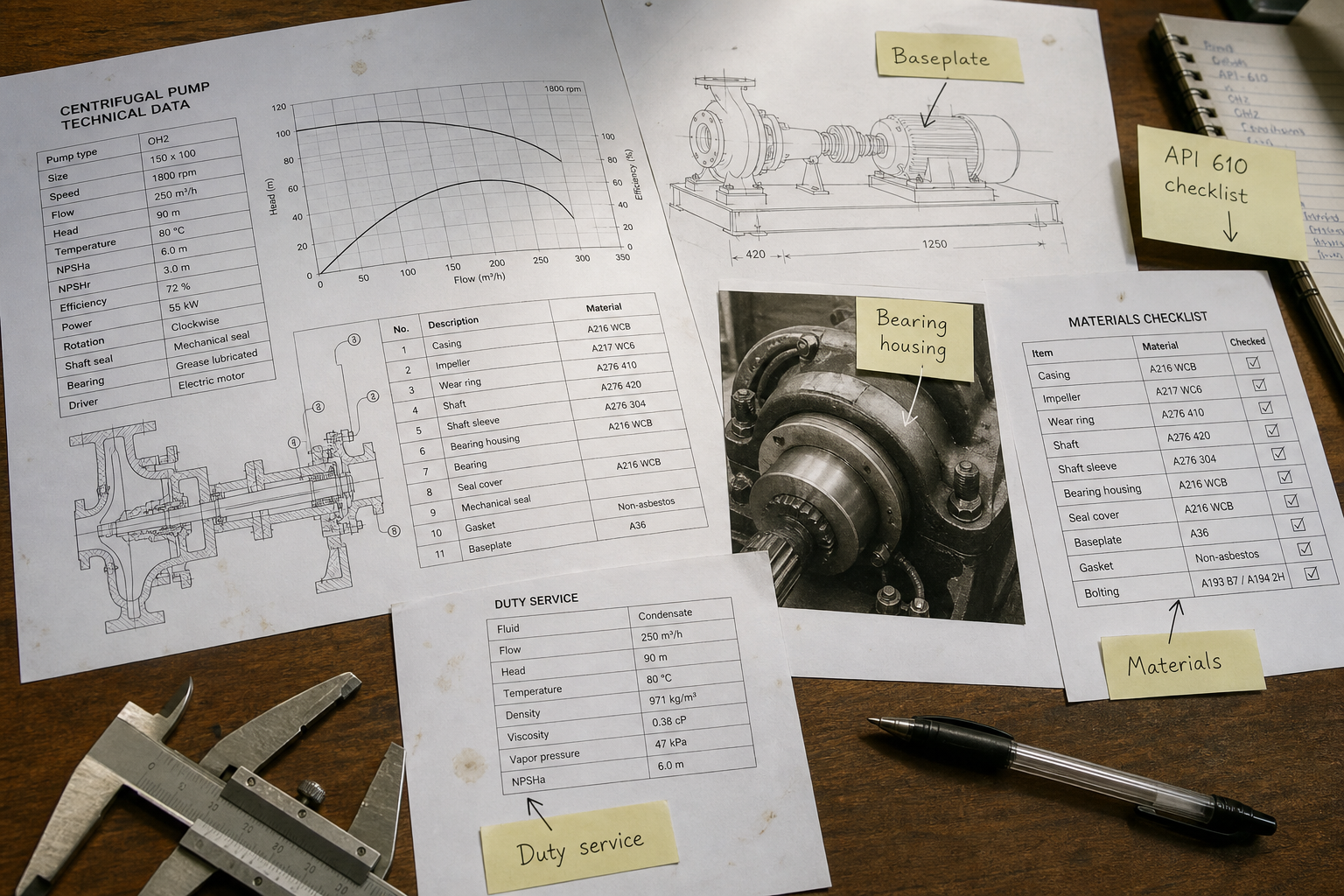
During the test, suction pressure, discharge pressure, shaft power, speed, and fluid temperature are measured simultaneously. The test uses water as the medium, and performance is corrected to the actual service fluid density and viscosity if specified. For a pump rated at 250 m³/h and 80 meters head, acceptance limits are 242.5 to 257.5 m³/h at 77.6 to 82.4 meters head.
Mechanical running tests verify vibration, bearing temperature, and seal leakage. Radial vibration at the bearing housings must remain below 3.0 mm/s RMS unfiltered. Bearing metal temperature rise above ambient cannot exceed 50°C at rated conditions. Mechanical seal leakage is limited to visible weeping—no drip formation—during a minimum two-hour run.
NPSH (net positive suction head) available at the site must exceed the pump’s NPSH required by at least 0.6 meters to prevent cavitation damage. API 610 requires the manufacturer to provide an NPSHR curve across the full operating range, not just a single value at best efficiency point. Selecting a pump without verifying NPSH margin leads to impeller pitting and performance loss within the first operating cycle.
**Test Parameter** | **API 610 Acceptance Limit** | **Measurement Method** |
Flow and head | ±3% of rated duty point | Calibrated flowmeter and pressure gauges |
Efficiency | Must meet or exceed datasheet value | Calculated from measured flow, head, and shaft power |
Vibration | ≤3.0 mm/s RMS unfiltered | Accelerometers at bearing housings |
Bearing temperature rise | ≤50°C above ambient | RTDs or thermocouples in bearing housing |
Seal leakage | No drip formation | Visual observation over two-hour test |
When API 610 Compliance Is Required
Petroleum refineries, gas processing plants, and petrochemical facilities typically mandate API 610 for all pumps handling hydrocarbons, corrosive intermediates, or high-temperature fluids above 120°C. The standard’s design margin and material rigor reduce unplanned downtime in continuous processes where a pump trip cascades into unit shutdown.
API 610 is not required—and adds unnecessary cost—for general water service, HVAC circulation, or intermittent-duty applications where failure consequences are low. A cooling water pump running at 40°C with municipal water can use ANSI B73.1 or ISO 5199 designs at half the capital cost.
The decision threshold is service criticality and operating severity. If the pump handles flammable liquids, operates continuously, or serves a process where failure triggers emergency depressuring or flaring, API 610 compliance justifies the premium. If the application is non-hazardous, intermittent, or has standby redundancy, a general-purpose pump meets the need without over-specification.
Interchangeability and Spare Parts Strategy
API 610 defines dimensional interchangeability within each pump type and size. An OH2 pump from one manufacturer must physically interchange with an OH2 from another manufacturer if both meet the same size designation and nozzle configuration. This interchangeability reduces spare parts inventory and allows second-source procurement without re-engineering piping and baseplates.
The standard specifies baseplate bolt patterns, suction and discharge nozzle sizes and orientations, coupling guard dimensions, and shaft height. Bearing housing bolt patterns are also standardized so that retrofit or emergency replacement doesn’t require field machining.
Interchangeability applies to major components: casing, rotating assembly, bearing frame, and mechanical seal. Minor components like gaskets, o-rings, and impeller wear rings are not interchangeable across manufacturers and must be stocked by brand.
This design philosophy reduces total cost of ownership over a 20-year asset life, even though the initial API 610 pump costs 40-60% more than a comparable ANSI pump. The savings come from faster turnaround during unplanned maintenance and reduced engineering effort when process changes require hydraulic upgrades.
FAQs
Can an API 610 pump handle slurries or solids-laden fluids?
API 610 does not address slurry service or abrasive solids. The standard assumes clean or lightly contaminated liquids typical of refined products and process intermediates. For slurries, crude oil with high sand content, or catalyst circulation, consult API 610 Annex H for erosion-resistant materials or consider API 676 rotary positive displacement pumps where abrasive wear is a primary design factor.
How does API 610 differ from ISO 13709?
ISO 13709 is the international version of API 610, adopted by the International Organization for Standardization with identical technical content. Equipment procured to ISO 13709 meets API 610 requirements. The dual designation exists because some regions and clients reference ISO standards rather than American Petroleum Institute publications. Verify which edition year matches between the two documents when specifying.
What seal flush plan is required under API 610?
API 610 mandates Plan 11 (recirculation from pump discharge) as the minimum acceptable flush for single mechanical seals in hydrocarbon service. Plan 13 (recirculation from discharge through cooler) is required when pumped fluid temperature exceeds the seal face material limit. Plan 53A or 53B (pressurized barrier fluid with bladder accumulator or pump) is specified for dual seals in flammable or toxic services where leakage to atmosphere is prohibited.
Does API 610 cover pump system design or only the pump itself?
API 610 covers the pump, baseplate, coupling, and auxiliary systems like seal flush and bearing lubrication. It does not address piping design, valve selection, or system hydraulics. Those elements fall under ASME B31.3 for process piping, API 686 for machinery installation, and hydraulic analysis per Crane TP-410 or equivalent. A complete pump package requires coordination across all three documents.
Conclusion
API 610 transforms a pump from a catalog item into a reliability asset by enforcing material integrity, mechanical margin, and hydraulic verification that match the operating severity of hydrocarbon and chemical process service. When selecting pumps for continuous-duty applications handling flammable or corrosive fluids above 120°C, confirm the manufacturer’s compliance with the current edition—11th edition as of this writing—and request certified test data for flow, head, vibration, and seal performance. For non-critical, low-temperature water service, ANSI or ISO general-purpose standards deliver adequate performance without the API 610 cost premium.
The interchangeability provisions reduce long-term spare parts costs and accelerate turnaround during unplanned maintenance, justifying the initial capital difference over a typical 20-year refinery asset life. Before issuing a purchase order, verify the pump type classification matches your mounting constraints, confirm material grades suit your fluid service class in Annex G, and ensure NPSH available exceeds NPSH required by at least 0.6 meters across the operating range.