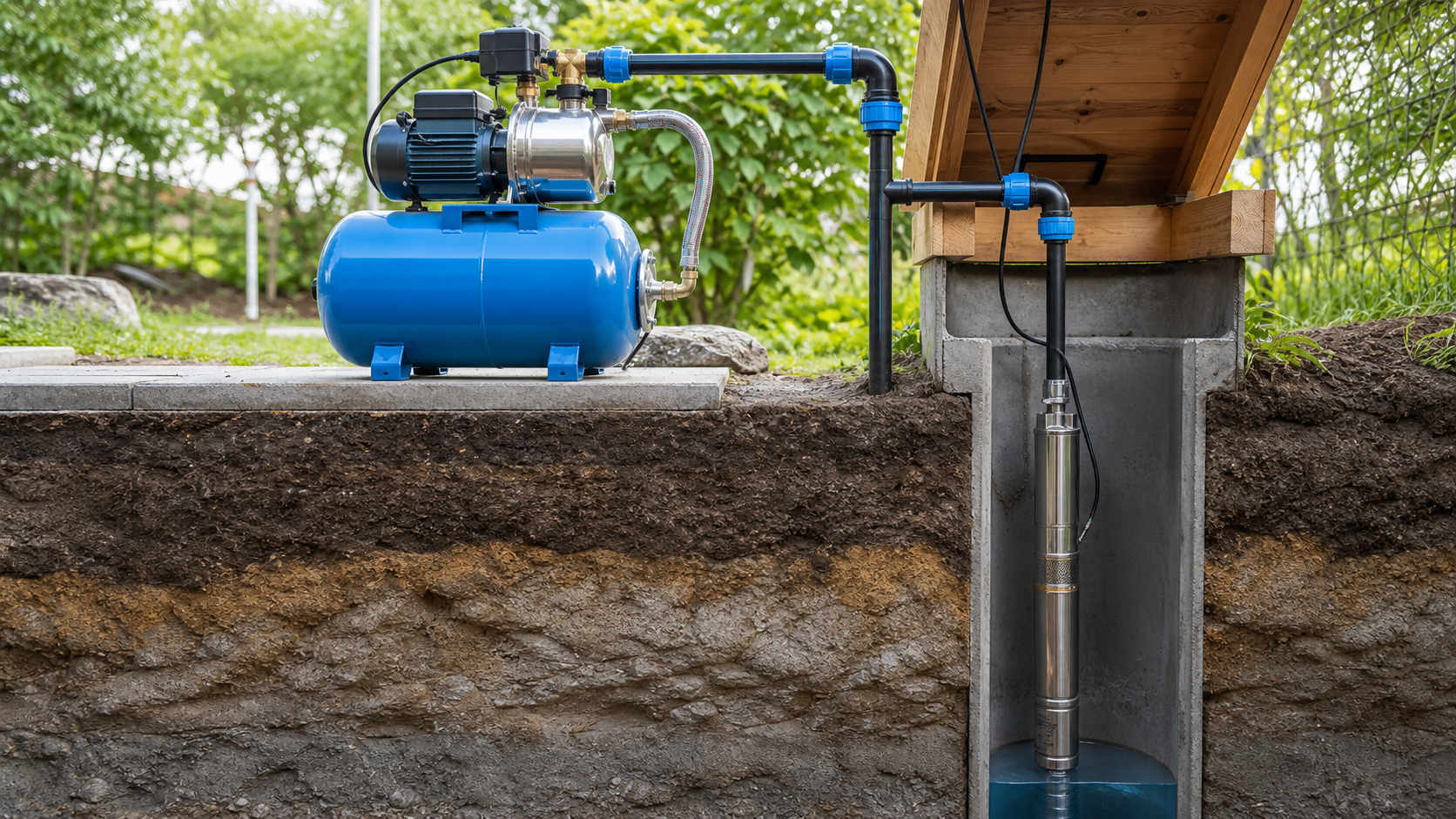
Stand at a wellhead and the choice is where electrical power becomes water movement. A jet pump sits above ground, using suction to lift water through piping or an ejector nozzle to boost pressure. A submersible pump hangs inside the well casing, converting motor rotation into discharge pressure below the water surface and pushing the column upward. This location difference controls depth capacity, priming needs, noise, cooling, maintenance access, and system efficiency. Jet pumps handle shallow wells with single-pipe configurations or deeper wells with ejector assemblies. Submersible pumps operate submerged, eliminate priming, run quietly, and require downhole service.
Key Takeaways
- Jet pumps remain above ground and use suction or an ejector to lift water; submersible pumps sit below the water surface and push upward, eliminating suction lift constraints.
- Shallow-well jet pumps face suction lift limits determined by atmospheric pressure and the pump’s NPSHr; ejector configurations extend reach but impose recirculation energy penalties.
- Submersible pumps typically deliver higher wire-to-water efficiency in deeper wells where ejector recirculation losses compound, though specific crossover depth depends on the system curve and pump model.
- Jet pumps allow motor and seal inspection without pulling equipment from the well; submersible pumps require cable and pipe disconnection and lifting equipment for service.
- Well diameter, water quality, required flow, total dynamic head, duty cycle, and electrical supply constrain the selection between jet and submersible arrangements.
The Main Difference Is Where the Pump Works
A jet pump motor, impeller, casing, and seal assembly remain above ground. The motor drives a centrifugal impeller that either creates suction directly in a shallow-well configuration or pressurizes a recirculation stream sent down the well to power an ejector nozzle in a deep-well configuration. Water enters through a suction pipe extending into the well, and the pump must overcome vertical lift, friction losses, and required discharge pressure. Atmospheric pressure limits theoretical suction lift to approximately 34 feet of water at sea level, but NPSHr requirements, friction, and temperature constraints reduce the practical operating range.
A submersible pump motor and multistage impeller stack sit submerged inside the well casing. The motor drives a series of impellers and diffusers that convert rotational energy into pressure. Water enters through a screen at the pump inlet, flows upward through the stages, and exits into the discharge pipe without any suction lift from the surface. The pump adds energy to water already under hydrostatic pressure, so atmospheric suction limits do not apply.
This location difference changes priming, cooling, noise transmission, maintenance access, and the energy balance at the duty point. A jet pump must either prime itself by filling the suction line or rely on a foot valve to hold prime. A submersible pump runs flooded and does not lose prime unless the water level drops below the intake screen.
How a Jet Pump Uses an Ejector and Recirculation
Shallow-well jet pumps use a single suction pipe and rely on impeller-generated vacuum to lift water. The impeller accelerates water inside the volute, creating low pressure at the impeller eye. Atmospheric pressure acting on the well water surface pushes water up the suction pipe to fill that low-pressure zone. The lifted water passes through the impeller and discharges to the system. This arrangement works when the vertical distance from the pump centerline to the water surface satisfies the pump’s NPSHr at the operating flow rate.
Deep-well jet pumps add an ejector assembly—a nozzle, venturi throat, and diffuser—located at the bottom of the well. The surface-mounted centrifugal pump sends a high-velocity jet of water through a pressure pipe to the submerged ejector nozzle. The nozzle accelerates this drive water, creating a low-pressure zone in the venturi throat. Well water is drawn into the throat by this suction effect, mixes with the drive water, and the combined stream passes through the diffuser where velocity converts back to pressure. The mixture returns to the surface through a larger suction pipe. The surface pump then re-pressurizes a portion of the flow and recirculates it back down the pressure pipe to sustain the ejector cycle, while the remainder feeds the discharge system.
Ejector recirculation imposes an energy penalty. The surface pump must circulate more flow through its impeller than the net flow delivered to the building, and this recirculation ratio increases with well depth. The extra flow increases motor load and reduces wire-to-water efficiency compared to a direct-lift arrangement.
How a Submersible Pump Pushes Water Up the Well
A submersible pump uses a vertically stacked series of centrifugal stages, each consisting of an impeller and diffuser. The motor shaft drives all impellers simultaneously. Water enters the first-stage impeller through a screen, gains velocity and pressure, exits into the first-stage diffuser where velocity converts to additional pressure, then enters the second-stage impeller at elevated pressure. Each stage adds head depending on impeller diameter, speed, and design.
The discharge from the top stage connects to a riser pipe that extends to the surface. The pump must generate enough head to overcome the vertical lift from the pump depth to the discharge point, plus friction losses in the riser pipe and surface piping, plus any residual pressure required at the point of use. The motor operates submerged in the well water, which provides cooling. Most submersible motors are sealed and oil-filled or use a water-cooled design that circulates well water around the motor housing.
Pump selection involves matching the system curve—total dynamic head versus flow rate—with the pump curve. The intersection defines the duty point. For a hypothetical example: a 200-foot deep well with 20 feet of drawdown under pumping conditions, a desired surface pressure of 40 psi (92 feet of head), and friction losses totaling 15 feet would require:
TDH = Static lift + Drawdown + Discharge pressure + Friction losses
TDH = 200 + 20 + 92 + 15 = 327 feet
A submersible pump with a curve showing 327 feet of head at the target flow rate would operate at its duty point. Running significantly off the curve reduces efficiency and risks cavitation or overload.
Depth, Suction Limits, Flow, Pressure, and Efficiency
Shallow-well jet pumps are constrained by atmospheric pressure and the pump’s NPSHr. The operating depth depends on the specific pump model, elevation, water temperature, and piping configuration. Within the suction-limited range, flow rate depends on impeller size, motor horsepower, and system resistance.
Deep-well jet pumps extend the operating range by using the ejector principle, but the recirculation flow increases energy consumption. The deeper the well, the larger the efficiency penalty.
Submersible pumps operate across a wider depth range without suction constraints. Flow rate and head capacity depend on stage count, impeller diameter, and motor size. Because the pump works against hydrostatic pressure rather than suction lift, efficiency characteristics differ from jet pump arrangements. In deeper wells, submersible pumps generally provide better wire-to-water efficiency than deep-well jet pumps, though the specific crossover depth depends on the manufacturer’s pump curve and the system operating point.
Performance depends on matching pump and system curves. A submersible pump rated for a specific flow at a given head will deliver less flow if the system requires higher head, and more flow if the system requires lower head. Operating far from the best efficiency point increases energy consumption, generates heat, and accelerates wear.
Noise, Priming, Cooling, and Maintenance Access
Jet pumps produce audible noise because the motor, impeller, and casing operate above ground. Vibration from the pump can transmit through piping and building structure if the pump is not properly isolated. For installations where noise is a concern, mounting the pump on a concrete pad with rubber isolators and using flexible connectors reduces transmission.
Submersible pumps run nearly silent because the motor and impeller are submerged and the well casing and water column attenuate sound. Surface noise is limited to water flow in the discharge pipe and any check valve or pressure switch operation.
Jet pumps require priming before initial startup. The suction line and pump casing must be filled with water to eliminate air, or the pump will not generate suction. A foot valve at the bottom of the suction pipe helps maintain prime between cycles, but foot valves can stick or leak. If prime is lost, the pump must be manually reprimed by filling the casing through a priming plug. Submersible pumps do not require priming because they operate submerged.
Jet pump motors rely on ambient air for cooling. Adequate ventilation in the pump house or mechanical room is necessary to prevent overheating, especially during high-duty cycles. Submersible motors are cooled by the surrounding well water. Minimum flow velocity past the motor housing is typically specified by the manufacturer to ensure adequate heat removal. If the pump is oversized and delivers low flow, or if the well diameter is too large, inadequate cooling can lead to motor failure.
Maintenance access strongly favors jet pumps. Motor inspection, bearing lubrication, seal replacement, and impeller cleaning are performed above ground with standard hand tools. A technician can isolate the pump, drain the casing, remove the motor or impeller, and complete repairs. Submersible pump service requires pulling the pump from the well, which involves disconnecting the power cable and discharge pipe, attaching lifting equipment, and hoisting the pump and motor assembly to the surface. The time and equipment cost for submersible pump service is higher, but service intervals are typically longer because the submerged environment protects the motor and seals from dust, temperature extremes, and weather.
Water Quality, Cable, Pipe, and Well-Diameter Constraints
Jet pumps handle clean water with minimal suspended solids. Sand, silt, or debris that enters the suction line will pass through the impeller and ejector nozzle, causing wear on impeller vanes, wear rings, and nozzle orifice. If the well produces sand, a sand separator or settling tank should be installed ahead of the jet pump. Well water quality affects both pump types, but jet pumps are more accessible for frequent inspection and cleaning.
Submersible pumps include an intake screen that blocks large debris, but fine sand can still enter the stages and wear the impellers, diffusers, and shaft bearings. Some submersible pump specifications indicate sand tolerance limits; exceeding these limits shortens bearing and seal life. In wells with chronic sand production, a sand shroud or gravel pack around the pump intake can reduce sand entry, or a surface sand separator can be installed on the discharge line.
Power supply to a submersible pump runs through a submersible cable suspended alongside the discharge pipe. The cable must be sized for the motor current and acceptable voltage drop over the cable length. Voltage drop calculations account for cable length, wire gauge, motor current, and supply voltage. The cable must be secured to the discharge pipe with cable guards or tape at intervals specified by the manufacturer to prevent abrasion and to control weight. Cable damage from rubbing against the casing or pipe, or from improper pulling during installation, is a leading cause of submersible pump failure.
Well diameter limits pump size. Jet pumps connect to the well through piping, so a narrow casing is sufficient. Submersible pumps must fit inside the casing with clearance for the cable and pipe. A 4-inch submersible pump requires a 4-inch or larger casing; a 6-inch pump requires a 6-inch or larger casing. Well diameter becomes a constraint when an existing shallow well with narrow casing needs to be converted to a submersible system.
Discharge pipe sizing affects system head and efficiency. For a given flow rate, smaller pipe diameter introduces higher friction losses per unit length. Undersized piping increases total dynamic head, pushes the operating point left on the pump curve, reduces flow, and wastes energy. The discharge pipe for a submersible pump must also withstand the weight of the water column and pump thrust, so schedule 80 PVC or galvanized steel is common for deep wells.
Selection Table for Well and Water-Supply Conditions
Condition | Jet Pump | Submersible Pump |
|---|---|---|
Well depth allows suction operation | Shallow-well jet pump. Lower equipment cost, easy maintenance access. | Submersible pump. Higher equipment cost, silent operation, no priming. |
Well depth in moderate range | Deep-well jet pump with ejector. Above-ground service, efficiency declines as depth increases. | Submersible pump. Better efficiency in this range, quiet, no priming, higher equipment cost, requires pulling for service. |
Deep well | Deep-well jet pump. Efficiency penalty increases with depth. | Submersible pump. Most efficient option for deep wells, higher equipment cost offset by lower energy use over time. |
Noise-sensitive location | Audible pump noise, requires isolation or enclosure, possible vibration transmission. | Nearly silent operation, no mechanical noise at surface. |
High-duty cycle or continuous operation | Higher energy cost due to recirculation losses in deep-well configurations, motor cooling by ambient air. | Lower energy cost, motor cooled by well water, designed for continuous duty. |
Frequent maintenance access | Motor, seal, and impeller accessible above ground, service with hand tools. | Requires pulling pump, labor-intensive, needs hoist or tripod. |
Sand or turbidity present | Accessible for cleaning, but sand accelerates wear on impeller and ejector nozzle. | Intake screen provides some protection, fine sand wears stages, harder to access for cleaning. |
Small well diameter | Compatible with narrow piping, no casing clearance required. | Requires casing diameter matching pump body diameter plus clearance. |
Existing shallow-well system | Continue with jet pump unless depth increases or efficiency becomes a priority. | Converting requires well diameter check, cable installation, discharge pipe upgrade. |
This table provides decision guidance, but final selection depends on measured well parameters, site-specific system curves, and manufacturer pump curves. A submersible pump is not automatically the correct choice—in a shallow well where a jet pump meets flow and pressure requirements, the simpler jet pump may be appropriate. Conversely, in a deep well with higher flow demand, a submersible pump typically delivers better performance and lower operating cost despite higher equipment price.
FAQs
Can a jet pump be converted to a submersible pump without drilling a new well?
Conversion depends on well casing diameter and depth. If the existing casing diameter accommodates a submersible pump body plus clearance for cable and pipe, a submersible pump can replace the jet pump. Disconnect the jet pump, remove the existing suction and pressure piping from the well, install a pitless adapter at the casing top, lower the submersible pump with attached discharge pipe and cable, connect the cable to a control box, and set the pressure switch and tank. If the casing is too narrow, a standard submersible pump will not fit. For shallow wells, the conversion may not improve performance enough to justify the cost.
What happens if a submersible pump runs dry or the water level drops below the intake?
Running dry removes the cooling water surrounding the motor and causes rapid overheating. The time to failure depends on motor size, thermal mass, and ambient well temperature. To prevent this, install a low-water cutoff sensor or a pump-down control that monitors water level and stops the pump before the intake is exposed. In wells with limited yield, the drawdown during pumping may temporarily expose the pump. Setting the pump deeper in the well—below the expected drawdown level—provides a buffer.
Why does a deep-well jet pump lose prime more often than a shallow-well jet pump?
Deep-well jet pumps depend on a foot valve at the ejector assembly to hold water in the suction line when the pump stops. If the foot valve leaks or sticks open, water drains back into the well and air fills the suction line. The longer vertical distance in a deep well means more water must drain before air reaches the pump, so even a small leak can cause prime loss over time. Shallow-well jet pumps also use foot valves, but the shorter suction line holds less water, and some shallow-well pumps can re-establish suction after minor air entry. Deep-well systems have no self-priming capability at the ejector, so foot valve integrity is critical.
Can a submersible pump be used in a lake, pond, or cistern instead of a well?
Yes, with proper intake protection. Submersible pumps are used in surface water sources, but the intake screen must be sized to prevent clogging from algae, leaves, or debris. A separate intake basket or strainer cage around the pump is common. The pump should be suspended at a depth that avoids surface turbulence and maintains submergence during seasonal water level changes. In freezing climates, the pump must remain below the ice layer. Power cable routing and anchoring differ from well installations because there is no casing to guide the cable. Check local regulations—some areas require backflow prevention or separate permits for non-well water sources.
How does well recovery rate affect the choice between jet and submersible pumps?
Well recovery rate—the gallons per minute the aquifer can deliver—must match or exceed the pump flow rate for continuous operation. If the pump delivers more flow than the well can recover, the water level will drop until the well runs dry or the pump cavitates. A submersible pump can be throttled or controlled with a variable frequency drive to match the recovery rate, reducing flow when water level drops and increasing flow when the well recovers. A jet pump can also be throttled, but deep-well ejector systems are less tolerant of flow variation because the ejector nozzle and recirculation balance are designed for a specific flow range. In wells with low recovery rates, a large storage tank and cycle control that runs the pump intermittently allows the well to refill between pumping cycles, making either pump type feasible if the tank is sized correctly.
Conclusion
Choosing between a jet pump and a submersible pump requires a well log showing static and pumping water levels, a system curve with total dynamic head at the design flow rate, and manufacturer pump curves for candidate models. For deeper wells, submersible pumps typically deliver better efficiency and lower lifetime energy costs. For shallow wells where noise is not a concern and maintenance access is valued, a jet pump may be cost-effective. Before finalizing the selection, verify that the well casing diameter accommodates the pump, the electrical service matches the motor requirements, and the discharge piping is sized to avoid excessive friction losses. A measured drawdown test under pumping conditions and a water quality report showing sand content will confirm whether additional intake protection or surface filtration is needed.