
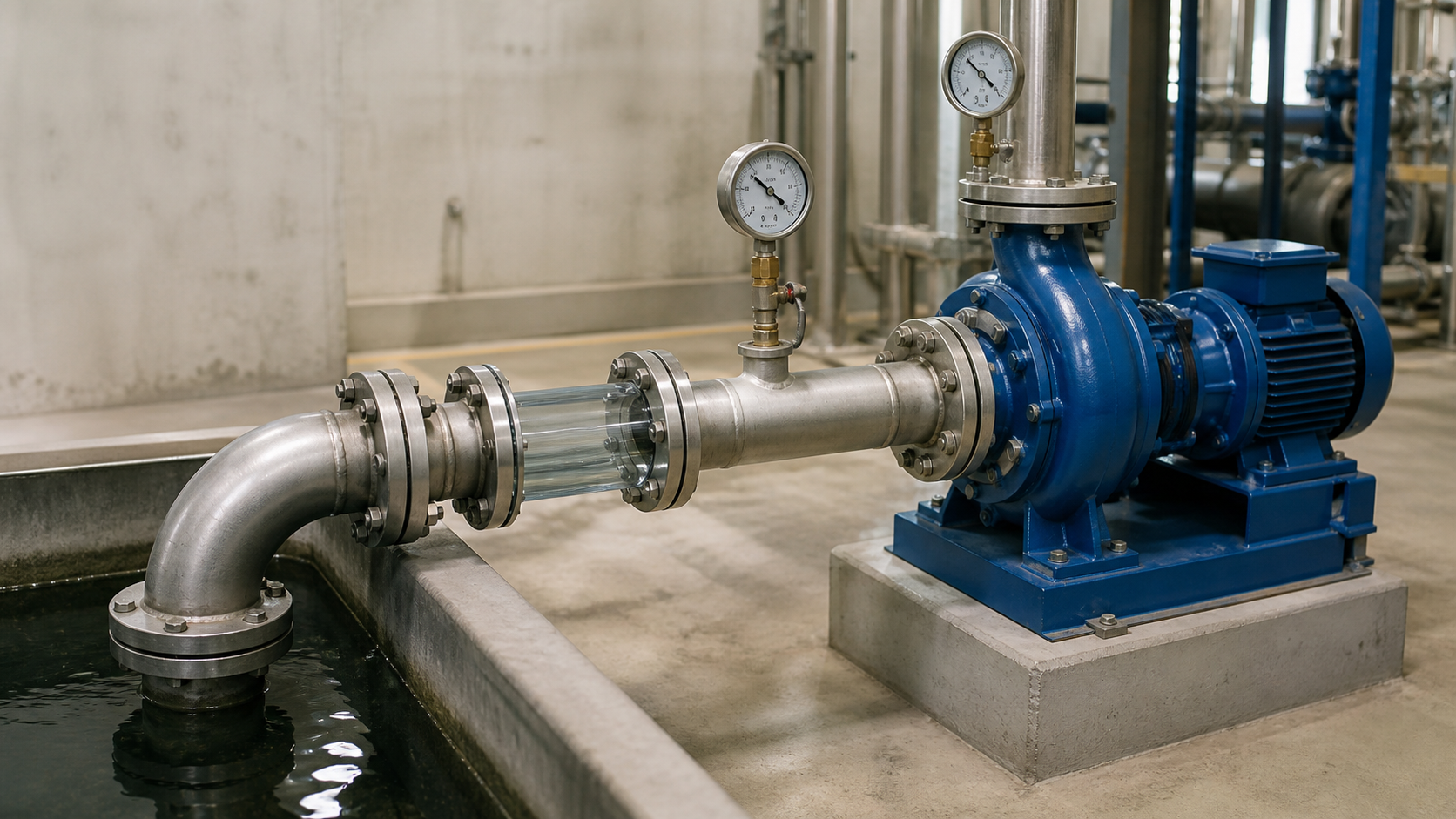
A centrifugal pump can show normal discharge pressure while cavitation damages the impeller. The discharge gauge reads what you expect, but noise, vibration, and flow loss tell a different story. The problem is at the inlet, where NPSH in pumps—net positive suction head—measures whether the liquid has enough pressure to enter the impeller without flashing to vapor. NPSHa (available) is the margin the system provides. NPSHr (required) is the minimum margin the pump demands at a given flow. When NPSHa falls below NPSHr, cavitation begins even if every other parameter looks correct.
Key Takeaways
- NPSH is the absolute pressure head at the pump suction flange, minus the liquid’s vapor pressure head, expressed in feet or meters of liquid column.
- NPSHa depends on the installed system: suction tank pressure, liquid level, pipe losses, elevation, temperature, and vapor pressure.
- NPSHr comes from the manufacturer’s test curve and varies with flow rate; it is not a fixed property of the pump model.
- The required margin is NPSHa > NPSHr, with an additional safety buffer for system transients and curve uncertainty.
- Raising tank level, lowering liquid temperature, reducing suction losses, or pressurizing the suction vessel all increase NPSHa; changing pump speed or impeller diameter changes NPSHr.
NPSH Is a Suction-Side Energy Margin
Net positive suction head quantifies the pressure energy available at the pump inlet to prevent the liquid from vaporizing as it accelerates into the impeller. At the impeller eye, velocity increases and local pressure drops. If that local pressure falls to the liquid’s vapor pressure, bubbles form. When those bubbles reach higher-pressure zones inside the impeller, they collapse violently, eroding metal surfaces and causing noise, vibration, and flow loss.
NPSH is expressed in units of head (feet or meters of liquid column) rather than pressure (psi or bar) because head remains constant for a given liquid column regardless of density. This simplifies calculations when fluid properties change. The governing principle is that the absolute pressure head at the suction flange must exceed the vapor pressure head by enough margin to accommodate friction losses and velocity head inside the pump.
Two distinct values define the operating boundary:
- Net positive suction head available (NPSHa): the actual head margin the installed system delivers to the pump suction flange.
- Net positive suction head required (NPSHr): the minimum head margin the pump needs to avoid cavitation at a specific flow rate.
Operation is safe when NPSHa exceeds NPSHr with adequate margin. When NPSHa drops below NPSHr, cavitation damage begins.
NPSHa Comes from the Installed System
NPSHa is determined entirely by the suction-side installation. It changes with operating conditions but is independent of pump selection. Every component between the suction source and the pump inlet affects NPSHa: tank pressure, liquid surface elevation, pipe diameter, fitting count, valve position, and liquid properties.
A common installation supplies the pump from an open atmospheric tank. The liquid surface is at atmospheric pressure. Gravity provides a static head if the tank sits above the pump centerline (positive suction head) or penalizes NPSHa if the pump sits above the liquid surface (suction lift). Friction losses in the suction pipe, fittings, and valves reduce the available head. Vapor pressure increases with temperature and subtracts from NPSHa because it represents the pressure at which the liquid will boil.
Closed or pressurized suction vessels add the vessel pressure to NPSHa. Vacuum conditions or suction lift subtract from it. Elevation above sea level reduces atmospheric pressure, lowering NPSHa for open tanks. Viscosity increases friction losses. Every bend, tee, reducer, valve, and strainer in the suction line consumes head.
The result is a system property that can be calculated before selecting a pump but must be verified against the chosen pump’s NPSHr curve.
NPSHr Comes from the Pump Test Curve
NPSHr is a pump-specific performance characteristic measured by the manufacturer during testing. It varies with flow rate and is published on the pump curve alongside head, efficiency, and power. At low flows, NPSHr is typically low. As flow increases toward and beyond the best efficiency point (BEP), NPSHr rises, often steeply.
The manufacturer determines NPSHr by running the pump at a fixed flow and progressively reducing suction pressure until a measurable head drop occurs (typically 3% head degradation). The test is repeated across the operating range to generate the NPSHr curve. This means NPSHr represents the onset of performance loss, not the complete absence of cavitation. Some bubble formation may already be present at the published NPSHr value.
NPSHr increases with pump speed. If a variable frequency drive (VFD) raises speed above the curve’s test condition, NPSHr rises according to the square of the speed ratio. Trimming or replacing the impeller changes NPSHr. Wear, particularly on impeller vanes and wear rings, can increase NPSHr over time. Always use the NPSHr curve for the actual impeller diameter, speed, and fluid tested.
Catalog curves are usually generated with cold, clean water. Pumping liquids with higher vapor pressure (hot water, hydrocarbons, volatile solvents) or higher viscosity requires special attention because NPSHr increases with viscosity and the margin shrinks with rising vapor pressure.
NPSHa Formula, Terms, and Consistent Units
The standard NPSHa formula for a suction tank open to atmosphere is:
NPSHa = P_atm / (ρ × g) ± h_s – h_f – P_vp / (ρ × g)
Where:
- P_atm = atmospheric pressure (absolute) at the site elevation, Pa or psf
- ρ = liquid density, kg/m³ or lb/ft³
- g = gravitational acceleration, 9.81 m/s² or 32.2 ft/s²
- h_s = static height from liquid surface to pump centerline, m or ft (positive if surface is above pump, negative if below)
- h_f = total friction loss in suction piping, fittings, and valves, m or ft
- P_vp = liquid vapor pressure (absolute) at pumping temperature, Pa or psf
Result is in meters or feet of liquid column.
For a pressurized or vacuum suction vessel, replace P_atm with the absolute pressure at the liquid surface inside the vessel.
Consistent unit groups:
Variable | SI Metric | US Customary |
|---|---|---|
Pressure | Pa (N/m²) | psf (lb/ft²) or convert psi × 144 |
Density | kg/m³ | lb/ft³ |
Gravity | 9.81 m/s² | 32.2 ft/s² |
Head | m | ft |
Temperature | °C | °F |
Common mistakes include mixing gauge and absolute pressure, using psi directly without converting to head, forgetting to subtract vapor pressure, or applying the wrong density. Absolute pressure must be used because vapor pressure is an absolute value. Atmospheric pressure at sea level is approximately 101,325 Pa (14.7 psi or 2,116 psf or 10.33 m of water or 33.9 ft of water). At 5,000 ft elevation, atmospheric pressure drops to roughly 12.2 psi (1,756 psf or 8.5 m or 28.2 ft of water).
Worked Example for an Open Suction Tank
System description:
- Water at 20°C pumped from an open storage tank
- Tank liquid surface is 3.0 m above pump centerline
- Suction pipe: 4-inch schedule 40 steel, 8 m long
- Fittings: two 90° elbows, one gate valve (fully open), one foot valve with strainer
- Flow rate: 150 m³/h (660 US gpm)
- Site elevation: 500 m above sea level
Given properties:
- Water density at 20°C: ρ = 998 kg/m³
- Water vapor pressure at 20°C: P_vp = 2,338 Pa (absolute)
- Atmospheric pressure at 500 m elevation: P_atm ≈ 95,500 Pa
- Friction loss (calculated from Darcy-Weisbach or tabulated): h_f = 1.2 m
Calculation:
- Convert atmospheric pressure to head:
- h_atm = P_atm / (ρ × g) = 95,500 / (998 × 9.81) = 9.76 m
- Static head (positive, tank above pump):
- h_s = +3.0 m
- Friction loss in suction line:
- h_f = 1.2 m
- Convert vapor pressure to head:
- h_vp = P_vp / (ρ × g) = 2,338 / (998 × 9.81) = 0.24 m
- Apply NPSHa formula:
- NPSHa = 9.76 + 3.0 – 1.2 – 0.24
- NPSHa = 11.32 m
Check against pump curve:
If the selected pump has NPSHr = 4.5 m at 150 m³/h, the margin is:
- NPSHa – NPSHr = 11.32 – 4.5 = 6.82 m
The margin of 6.82 m in this hypothetical example would accommodate typical system transients, valve operation, and level variation. If the tank level drops by 2 m, NPSHa decreases to 9.32 m, maintaining 4.82 m margin. If water temperature rises to 60°C, vapor pressure increases to approximately 19,900 Pa (2.03 m head), reducing NPSHa to 9.53 m and margin to 5.03 m.
Why Temperature, Elevation, Losses, and Level Change the Margin
NPSHa is sensitive to every variable in the formula. Small changes in operating conditions can push a marginal installation into cavitation.
Temperature affects vapor pressure exponentially. Water at 20°C has a vapor pressure of 2,338 Pa. At 80°C, vapor pressure rises to 47,400 Pa—a twentyfold increase. The vapor pressure head at 80°C is approximately 4.8 m, compared to 0.24 m at 20°C. This 4.6 m loss in NPSHa can eliminate the entire safety margin if the system was sized for cold water. Hydrocarbon and chemical applications face even steeper vapor pressure curves.
Elevation reduces atmospheric pressure. At sea level, atmospheric pressure contributes roughly 10.3 m (33.9 ft) of head. At 2,000 m (6,562 ft) elevation, atmospheric pressure drops to about 79,500 Pa, contributing only 8.1 m (26.6 ft). Installations designed at sea level and moved to high altitude lose 2.2 m of NPSHa without any physical change to the system.
Friction losses increase with flow rate, pipe length, roughness, and the number of fittings. A partially closed suction valve, fouled strainer, or undersized pipe dramatically reduces NPSHa. Doubling the flow rate roughly quadruples friction loss. Viscosity increases friction losses, particularly in cold fuel oil or chemical applications where suction line heating may be required.
Liquid level in the suction tank directly changes static head. If a tank with normal level 3 m above the pump drops to 1 m during low-level operation, NPSHa decreases by 2 m. Level switches, alarms, and control logic must account for minimum acceptable NPSHa at low-level conditions. Conversely, raising tank elevation or using a booster pump increases NPSHa but adds cost and complexity.
Submergence in vertical or submersible installations provides static head equal to the depth of the impeller below the liquid surface. Lowering the pump deeper increases NPSHa. However, vertical pumps require careful analysis because the suction bell or first-stage impeller location, not the pump mounting flange, determines the effective static head.
NPSH Margin, Cavitation Evidence, and Design Checks
Operating exactly at NPSHr is insufficient. The published NPSHr represents incipient cavitation, not safe operation. A safety margin accounts for:
- Curve uncertainty and manufacturing tolerances
- Suction system transients (valve operation, level swings, pump start/stop)
- Wear increasing NPSHr over time
- Temperature variation increasing vapor pressure
- Flow variation moving the operating point on the NPSHr curve
The required margin depends on the specific pump, application, operating conditions, and manufacturer recommendations. Critical or high-energy pumps benefit from larger margins. Single-suction pumps and higher-specific-speed designs are more sensitive and require greater margin.
Cavitation evidence includes:
- Noise: gravel or crackling sound at the pump suction
- Vibration: increased amplitude, particularly at high frequencies
- Performance loss: reduced flow and head at constant speed
- Material damage: pitting on impeller vanes, especially the inlet (eye) and low-pressure (suction) side
- Shortened seal and bearing life due to vibration and axial thrust imbalance
Field checks to verify adequate NPSH:
- Record suction pressure gauge reading and convert to absolute pressure head
- Measure liquid temperature and look up vapor pressure
- Confirm flow rate and verify operating point on pump curve
- Check NPSHr at that flow from the certified curve
- Calculate NPSHa from measured conditions and compare to NPSHr plus required margin
- Monitor for noise, vibration, and performance degradation
- Inspect impeller at next maintenance interval for cavitation damage
Design-stage checklist:
- Calculate NPSHa for worst-case conditions: highest temperature, lowest tank level, highest flow, highest elevation, maximum friction loss
- Verify NPSHa exceeds NPSHr by the margin specified by the manufacturer at the duty point and across the expected operating range
- Review pump curve for steep NPSHr rise near shutoff or end-of-curve
- Confirm suction piping is short, direct, and adequately sized
- Eliminate air pockets, high points, and eccentric reducers on the suction side
- Verify foot valve, strainer, and fittings are sized for low pressure drop
- Consider a booster pump or pressurized suction tank if NPSHa is marginal
- Document assumptions and provide NPSHa calculation to the equipment supplier for confirmation
FAQs
Can I use the same NPSH margin for all pump types and sizes?
No. Larger, higher-energy pumps and those with higher specific speed or single-suction designs are more sensitive to NPSH deficiency and require greater margin. Consult the pump manufacturer’s recommendation for the specific model and application, as the required margin depends on pump design, operating conditions, and criticality.
What happens if NPSHa is only slightly below NPSHr?
Performance degrades gradually. You may observe head loss, increased noise, and vibration before visible damage occurs. Over time, cavitation erosion pits the impeller, roughens surfaces, and reduces efficiency. Bearings and seals wear faster due to vibration and axial loads. Operating in this condition shortens component life even if the pump still delivers flow. Correct the condition promptly by reducing flow, lowering temperature, raising liquid level, or reducing suction losses.
Does NPSHr change if I throttle the discharge valve?
Yes, indirectly. Throttling the discharge valve reduces flow rate, which moves the operating point left on the pump curve. NPSHr decreases as flow decreases, improving the margin. However, throttling also generates heat, increases power consumption, and can cause minimum-flow problems. If the goal is to improve NPSH margin, addressing the suction-side issue (temperature, level, piping losses) is more effective than throttling discharge.
How do I calculate NPSHa for a closed or pressurized suction tank?
Replace atmospheric pressure with the absolute pressure inside the tank. For a tank pressurized to 10 psig (68,950 Pa gauge) at sea level, the absolute pressure is 10 + 14.7 = 24.7 psia (170,275 Pa absolute). Convert this to head and substitute into the NPSHa formula in place of atmospheric pressure. For vacuum tanks, the absolute pressure is below atmospheric, reducing NPSHa. Always use absolute pressure values for both tank pressure and vapor pressure.
Is there a maximum NPSH value that could harm the pump?
Excessive NPSHa does not harm the pump, but it may indicate an unnecessarily deep suction sump, tall vertical column, or high suction pressure that complicates installation or increases cost. In vertical turbine and deep-well applications, very high submergence can increase shaft length, bearing loads, and alignment sensitivity. Vertical pumps must balance NPSH margin against mechanical constraints. For horizontal pumps, high NPSHa is benign as long as the suction pressure remains within the casing and seal pressure rating.
Conclusion
NPSH in pumps separates reliable operation from cavitation damage. Calculate NPSHa from the actual system conditions—tank pressure, level, temperature, elevation, and losses—and confirm it exceeds the pump’s NPSHr by the manufacturer-specified margin across the operating envelope. Gather the installed suction piping isometric, the liquid properties at maximum pumping temperature, and the certified pump curve with NPSHr data, then verify the margin at both the duty point and the extremes of expected level and temperature variation.