
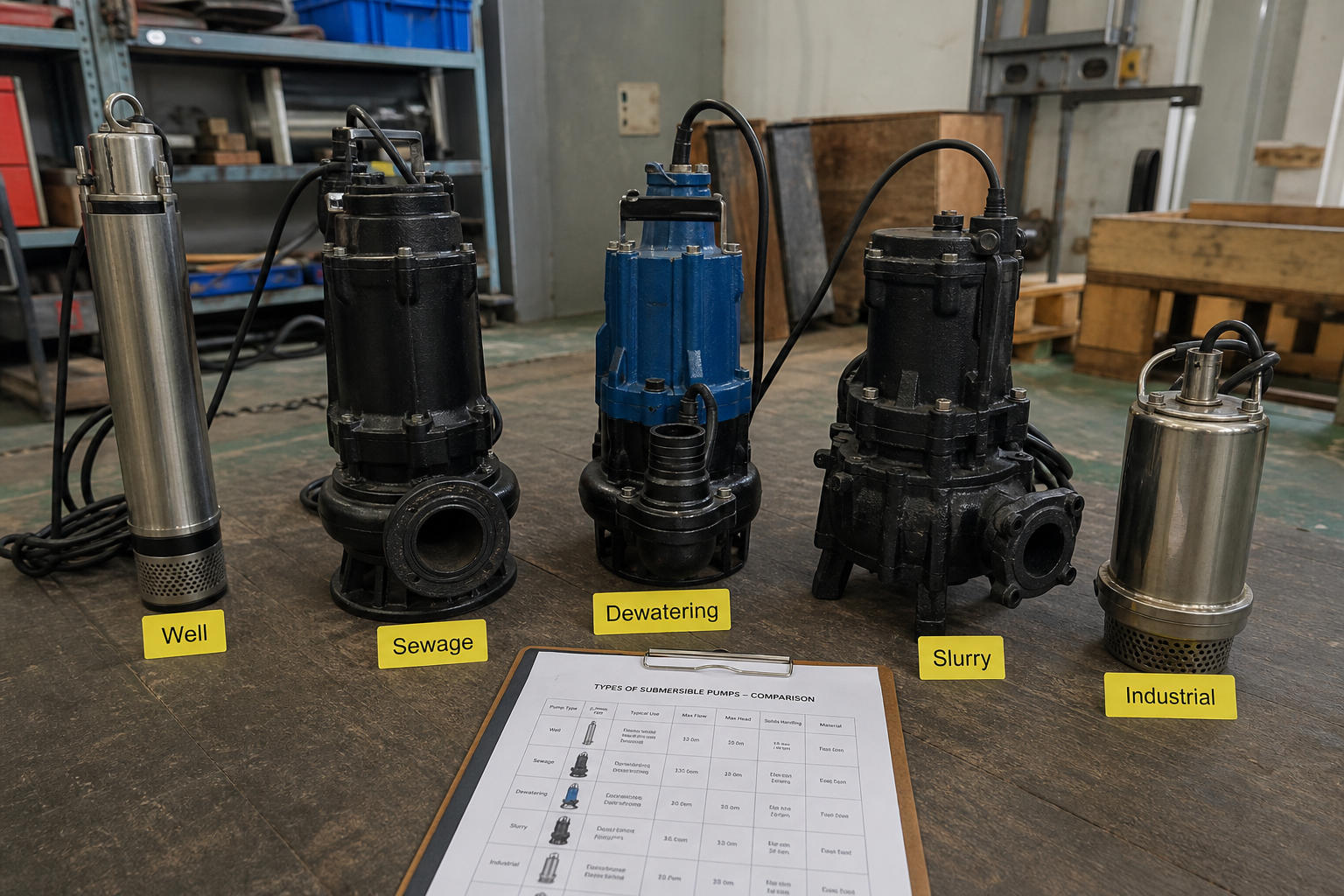
Field-style article image prepared for types of submersible pumps.
The main types of submersible pumps look similar from the outside, but they are not interchangeable. A well pump, sewage pump, dewatering pump, slurry pump, and industrial submersible use different cooling paths, impeller clearances, seal arrangements, and materials. Choosing by horsepower or outlet size alone can put the motor, seal, or hydraulics in the wrong duty.
Submersible pumps are motor-driven units designed to operate fully submerged in the fluid they move, with the motor sealed in an oil-filled or resin-potted housing below or integrated with the pump hydraulics. The five primary types—well, sewage, dewatering, slurry, and industrial process—differ in solids-handling capability, motor cooling design, seal arrangement, materials of construction, and hydraulic geometry.
Key Takeaways
- Well pumps use small-diameter stages for deep installations with clean water; motor cooling depends on flow past the housing.
- Sewage pumps incorporate vortex or channel impellers to pass solids up to 3 inches and rely on external liquid for motor heat rejection.
- Dewatering pumps prioritize portability and high head in temporary installations; they tolerate sand but not stringy debris.
- Slurry pumps feature hard-metal impellers, abrasion-resistant liners, and large-clearance hydraulics for mining and dredging duties.
- Industrial submersibles combine application-specific materials, hazardous-area motor certifications, and process-fluid compatibility for chemical, oil, and power-generation installations.
Well Submersible Pumps
Well submersible pumps are multistage centrifugal designs constrained by borehole diameter, typically 4 to 12 inches. Each stage adds 10 to 50 feet of head; a 10-stage pump in a 6-inch casing delivers 300 to 400 feet of total dynamic head at flows between 10 and 100 GPM.
The motor sits below the pump bowl stack. Clean water passes upward through the pump stages and around the motor housing, rejecting heat to the fluid. Sand content above 50 ppm accelerates wear on the stage bearings and throttle bushings.
Cable entry uses a shrouded splice or molded connection rated for continuous submersion. The pump must remain submerged at least 10 feet above the motor top during operation, or the cooling flow becomes insufficient and the motor overheats within minutes.
Well pumps are not designed for debris, fibers, or entrained air. Applications include municipal water supply, irrigation, and geothermal loop circulation where the fluid is filtered by the aquifer formation.
Sewage Submersible Pumps
Sewage pumps handle wastewater containing solids, grease, and fibrous material. The hydraulics use a vortex impeller—which creates a recirculation pattern without direct contact—or a single-channel or multi-channel impeller with passages sized to pass solids between 1 and 3 inches in diameter.
Motor cooling is external. The pump housing acts as a heat exchanger; the surrounding sewage absorbs heat conducted through the motor casing. If the liquid level drops below the motor during operation, the unit loses cooling capacity and thermal shutdown occurs within 5 to 15 minutes depending on load.
A double mechanical seal with an oil-filled chamber isolates the motor from the process fluid. Seal failure monitoring is standard on units above 5 HP; a moisture sensor or thermal detector in the seal chamber triggers an alarm before the motor floods.
Cast iron or ductile iron construction is typical for municipal installations. Stainless steel housings are specified for industrial wastewater with pH below 5 or above 10, or where hydrogen sulfide concentrations exceed 20 ppm.
Installation depth is limited by NPSHa and suction-side air entrainment. The pump inlet must remain at least 2 feet below the minimum liquid level to prevent vortexing, which introduces air and destabilizes the hydraulic performance.
Dewatering Submersible Pumps
Dewatering pumps are portable, single-stage units designed for temporary construction, mining, or emergency flood response. They generate high head—50 to 150 feet TDH—at moderate flows, typically 50 to 500 GPM.
The semi-open impeller tolerates sand and silt but not trash or long fibers. Spherical solids up to 0.5 inches pass through the hydraulics without clogging. The pump base includes an integrated strainer or a wear plate that allows the unit to sit directly on a sump floor and pump down to a residual level of 1 to 2 inches.
Motor cooling relies on external liquid circulation. If the dewatering process exposes the motor housing, runtime is limited to the thermal mass of the motor—usually 3 to 5 minutes before automatic cutoff. Level switches or float controls are mandatory to prevent dry running.
Standard construction is cast iron with a nitrile rubber seal. Abrasive applications specify hardened impeller tips and ceramic-silicon carbide seal faces to extend wear life beyond 2,000 hours of runtime in sandy water.
Slurry Submersible Pumps
Slurry pumps move high-density mixtures of water and abrasive solids in mining, dredging, and aggregate processing. The design prioritizes wear resistance over efficiency. A heavy-duty open or recessed impeller passes solids up to 4 inches; large internal clearances reduce contact between the rotating and stationary components.
Hard-metal impellers use high-chromium white iron (27% Cr) or rubber-lined designs for severe abrasion. The volute casing is lined with replaceable wear plates or elastomer liners that are field-serviceable without pulling the entire assembly.
Slurry density affects motor loading. A pump sized for 1,200 GPM at 1.2 specific gravity draws 35 HP; the same hydraulic duty at 1.5 specific gravity requires 44 HP. Motor selection must account for maximum expected slurry density, not just the design-point condition.
Agitator attachments are common. A side-mounted or bottom-mounted agitator prevents solids from settling around the pump inlet, maintaining a homogeneous slurry feed. Without agitation, settled solids can bury the pump and block suction within hours in high-concentration applications.
Slurry pumps are not intended for clean-water duty. Operating the pump without solids causes the internal clearances to vibrate and the wear surfaces to overheat due to loss of the slurry’s lubricating effect.
Industrial Submersible Pumps
Industrial submersible pumps are application-engineered units for chemical processing, oil production, power generation, and wastewater treatment in corrosive or hazardous environments. They combine fluid-specific materials, explosion-proof motor enclosures, and process control integration.
Material selection is driven by fluid compatibility. Pumps handling sulfuric acid use 316L stainless steel or Hastelloy wetted parts; caustic service specifies Alloy 20 or nickel alloys. Elastomer seals are matched to the process fluid—Viton for hydrocarbons, EPDM for water-based chemicals, Kalrez for extreme temperatures or aggressive solvents.
Motor enclosures meet hazardous-area classifications. Class I Division 1 installations for flammable liquids require explosion-proof housings and intrinsically safe control circuits. The motor cooling method must function in the process fluid; if the fluid temperature exceeds 105°F, external cooling jackets or heat exchangers are required to maintain motor winding temperature below the insulation class limit.
Control integration includes analog output for flow and pressure, digital communication via Modbus or Profibus, and remote monitoring of vibration, seal temperature, and winding resistance. Variable frequency drives are standard on units above 10 HP to manage starting current and adjust flow without throttling valves.
Industrial pumps are specified with detailed construction and test requirements. Mill test reports, material traceability, hydrostatic pressure testing to 1.5 times rated pressure, and witness testing at the factory are common contract requirements.
Submersible Pump Type Selection Framework
Pump Type | Solids Handling | Typical Head Range | Motor Cooling | Primary Applications |
Well | None; < 50 ppm sand | 100–1,000 ft | Internal flow past motor | Potable water, irrigation, geothermal |
Sewage | 1–3 inch spherical | 20–100 ft | External liquid contact | Municipal wastewater, lift stations |
Dewatering | 0.5 inch; sand tolerant | 50–150 ft | External liquid contact | Construction sites, mines, emergency response |
Slurry | 2–4 inch; high density | 30–120 ft | External liquid contact | Mining, dredging, ash handling |
Industrial | Application-specific | 20–300 ft | External or jacket cooling | Chemical, oil, power, process wastewater |
Selection starts with fluid properties: solids content, particle size, density, temperature, pH, and chemical composition. Match these to the pump type’s solids-handling capability and materials of construction.
Next, calculate the required hydraulic duty: flow rate in GPM and total dynamic head in feet, including static lift, friction loss, and pressure head. The pump curve must intersect the duty point within the preferred operating range—typically 70% to 110% of best efficiency flow.
Verify motor cooling. The liquid level during operation must cover the motor housing by at least the manufacturer’s specified margin, usually 1 to 3 feet. If the application involves intermittent or variable liquid levels, use level control with pump shutdown below the minimum submergence.
Confirm seal and motor protection. Double mechanical seals are standard for sewage, slurry, and industrial duties. Seal failure detection and automatic shutdown prevent motor damage when the seal chamber loses integrity.
FAQs
Can a sewage pump be used for dewatering construction sites?
Sewage pumps work for dewatering only if the excavation contains no sand or grit. The vortex or channel impeller passes soft solids but wears rapidly when pumping sandy water. A dewatering pump with a semi-open impeller and hardened components is the correct choice for construction sites where sand content is expected.
What happens if a well pump runs partially submerged?
The motor overheats within 5 to 10 minutes because cooling flow around the housing is insufficient. Thermal overload protection will trip the motor offline, but repeated thermal cycling degrades the winding insulation and shortens motor life. Well pumps must remain fully submerged during operation.
How do you size a slurry pump for variable-density service?
Size the motor for maximum expected slurry density, not the average or design-point density. Calculate brake horsepower at maximum density using BHP = (Q × H × SG) / (3,960 × efficiency), where Q is flow in GPM, H is head in feet, and SG is specific gravity. Add a 15% service factor to the motor rating to handle transient density spikes.
Are industrial submersible pumps suitable for flammable liquids?
Yes, when the motor is rated for the hazardous area classification and the materials are compatible with the liquid. Class I Division 1 motors are required for flammable liquid service. Verify that the cooling method functions in the process fluid and that the seal system prevents vapor release.
Conclusion
Selecting the correct submersible pump type requires matching solids-handling geometry, motor cooling design, and materials of construction to the specific fluid and installation. Well pumps are limited to clean water in deep, narrow installations. Sewage and dewatering pumps handle solids but differ in hydraulic design and portability. Slurry pumps prioritize abrasion resistance over efficiency. Industrial submersibles combine application-specific materials and hazardous-area certifications for process environments. Confirm fluid properties, calculate hydraulic duty, and verify motor submergence before specifying the pump. For process or hazardous installations, include mill test reports and material traceability in the purchase specification.