
When comparing vertical inline fire pumps to end suction fire pumps, the choice hinges on installation footprint, maintenance access, suction conditions, and system pressure requirements. Vertical inline pumps mount directly in the pipeline and save floor space, making them ideal for tight mechanical rooms where every square foot counts. End suction pumps require a separate baseplate and alignment but offer easier impeller access and better tolerance for poor suction conditions. Both can meet NFPA 20 requirements when properly selected, but the site geometry and maintenance strategy usually decide which type performs better over the pump’s service life.
Key Takeaways
- Vertical inline pumps eliminate the baseplate and coupling, reducing footprint by 40-60% compared to end suction designs in the same duty range.
- End suction pumps handle cavitation, air entrainment, and variable suction conditions more reliably because the impeller eye is larger and the suction nozzle is horizontal.
- Fire pump installations must satisfy NFPA 20 regardless of pump type—verify controller listing, suction piping, and test header requirements before finalizing the design.
- Maintenance access matters: inline pumps require vertical clearance for motor removal, while end suction pumps need horizontal clearance for coupling and seal work.
- Document flow, total dynamic head, suction lift or flooded suction, liquid temperature, voltage, and available floor space before requesting a proposal.
How the Two Pump Types Differ in Fire Service
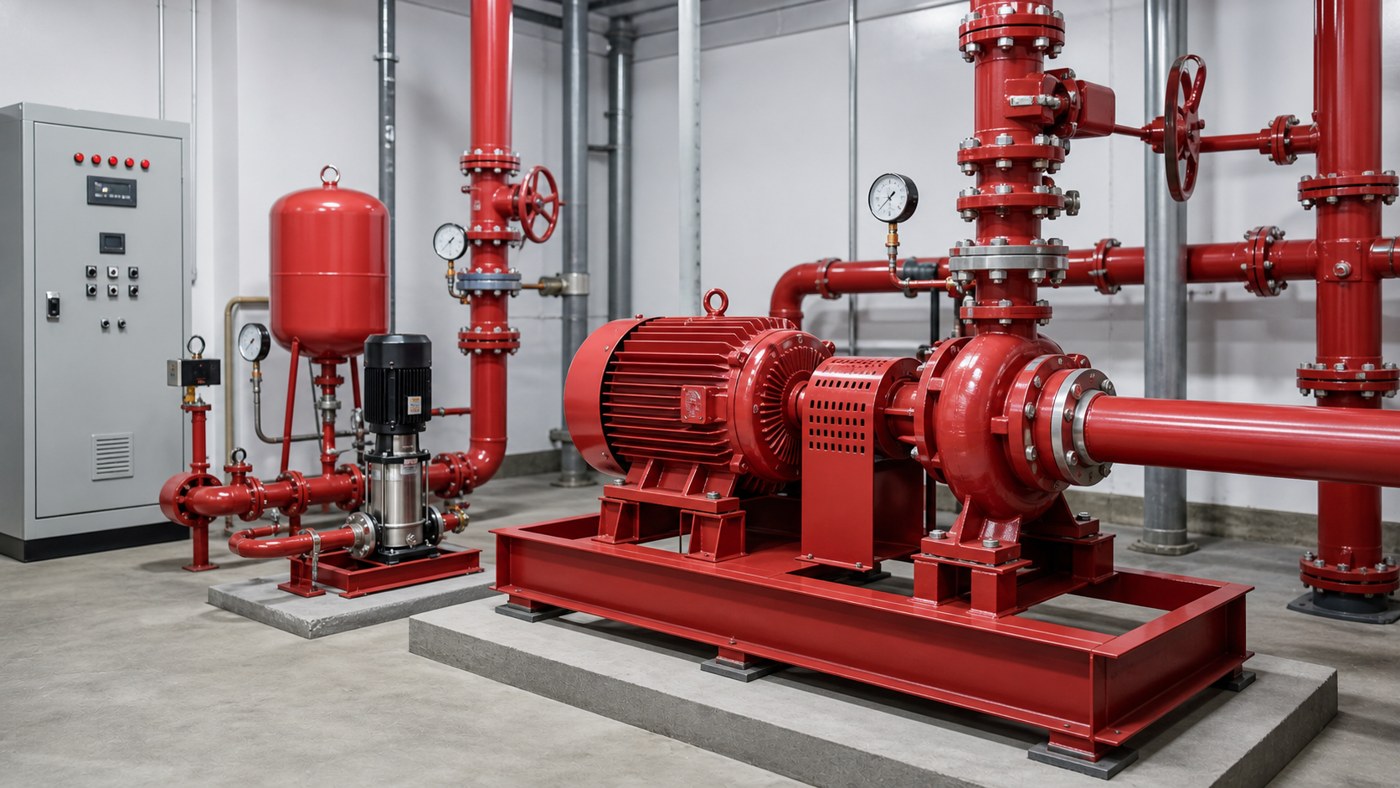
A vertical inline fire pump is a close-coupled centrifugal pump where the motor mounts directly above the pump body with a rigid shaft connection. The suction and discharge nozzles align vertically or inline with the piping, so the pump becomes part of the pipe run. This arrangement eliminates the baseplate, coupling guard, and horizontal piping offsets that end suction pumps require.
An end suction fire pump pulls water through a horizontal suction nozzle on one end of the casing and discharges it through a top or side outlet. The pump sits on a baseplate with a flexible or rigid coupling connecting it to a separate motor. This traditional layout provides independent access to the impeller, seal, and motor, but occupies more floor area and requires precise alignment during installation and after maintenance.
Both pump types can achieve UL listing and FM approval for fire service, but the mechanical differences create distinct installation and operational tradeoffs. In a high-rise building with limited mechanical room space, inline pumps allow designers to keep the fire pump assembly within a smaller footprint. In an industrial facility where maintenance staff routinely inspect impellers for wear or debris, end suction pumps reduce downtime because the casing can be opened without disturbing the motor or piping.
Decision Framework for Real Fire Pump Projects
The decision starts with the system demand. Fire pumps typically operate at rated flow with total dynamic heads between 40 and 150 psi, depending on building height, sprinkler density, and hose stream allowance. Both pump types cover this range, so hydraulic performance alone rarely disqualifies either option.
| Selection Factor | Vertical Inline Advantage | End Suction Advantage |
|---|---|---|
| Floor space | Compact footprint, no baseplate extension | Requires 2-3x more floor area for motor and coupling |
| Suction lift capability | Limited to 10-15 ft depending on NPSHR | Handles 15-25 ft lift with proper impeller design |
| Impeller access | Must remove motor and upper casing | Open casing with motor in place |
| Seal replacement | Requires motor removal or seal cartridge design | Access from front of pump without motor disturbance |
| Alignment | Factory-aligned, no field adjustment | Requires field alignment after installation or maintenance |
| Vertical clearance | Needs headroom for motor lifting | Minimal overhead clearance required |
Consider a 1500 GPM fire pump serving a 12-story building. If the fire pump room sits in a basement mechanical space with an 8-foot ceiling and limited floor area, a vertical inline pump fits the constraint because it occupies roughly 4 feet by 3 feet of floor space and the motor extends upward. The same duty in an end suction configuration would need approximately 8 feet by 4 feet to accommodate the baseplate, motor, coupling, and service clearance.
Now consider the same building where the water source is a 20-foot suction lift from an underground storage tank. The inline pump may struggle to meet NPSH requirements without an expensive suction booster, while a properly selected end suction pump with a large impeller eye and low NPSHR handles the lift directly. This is why suction condition—not just floor space—must drive the pump type decision.
Installation and Maintenance Considerations
Vertical inline fire pumps ship as a complete assembly with motor, pump, and rigid coupling already aligned. Installation involves bolting flanges to the suction and discharge piping and connecting electrical service. The simplicity reduces installation labor, but creates a service tradeoff: any work on the mechanical seal, impeller, or lower bearing requires lifting the motor and upper casing as a unit. In a mechanical room with a monorail or adequate ceiling height, this is manageable. In a low-clearance basement or penthouse, it becomes a rigging problem.
End suction fire pumps require baseplate grouting, motor-to-pump alignment, and coupling installation during commissioning. This adds labor hours upfront but pays back during maintenance. To inspect the impeller, a technician removes the casing bolts and swings the casing open without touching the motor. Seal replacement, bearing inspection, and wear ring checks all happen from the front of the pump with the motor running in place for initial checks.
Fire pump controllers add another layer. NFPA 20 requires automatic start on pressure drop and manual stop only. Both pump types connect to listed fire pump controllers the same way, but the controller must match the motor voltage, phase, and starting method. If the project specifies reduced-voltage starting due to utility limitations, verify that the controller and pump combination has been tested and listed together, because not all inline pump models support every starting method.
Field Verification Before Finalizing Selection
Before approving a vertical inline or end suction fire pump, confirm the following site conditions. Missing any of these can lead to a pump that meets the hydraulic spec but fails in service or cannot be maintained economically.
- Suction source: Is the water supply a flooded suction from a tank above the pump, a suction lift from a tank below, or a suction from a municipal connection? Measure the static height difference and confirm whether the suction line is always full or may contain air.
- Available NPSH: Calculate net positive suction head available based on atmospheric pressure, static head, friction loss in suction piping, and vapor pressure at maximum expected water temperature. Compare this to the pump’s NPSHR at rated flow with a safety margin of at least 3 feet.
- Ceiling height and rigging: For inline pumps, measure from the discharge flange to the ceiling and confirm whether a chain hoist, monorail, or adequate clearance exists to lift the motor during service.
- Floor load capacity: Fire pumps and controllers are heavy. Verify that the floor structure supports the combined weight of pump, motor, water in casing, and controller without reinforcement.
- Pipe support: Both pump types require independent pipe support so that thermal expansion, water hammer, and pipe weight do not load the pump flanges. Inline pumps are especially sensitive to piping strain because the pump body supports the motor weight.
- Test header location: NFPA 20 requires a flow test connection. Confirm that the discharge piping layout allows for the test header, flow meter, and hose valve without interfering with room access or other equipment.
Common Mistakes That Lead to Field Problems
Choosing a fire pump by catalog duty alone ignores the system details that determine whether the pump will start reliably and run for 30 years. One frequent mistake is selecting an inline pump for a suction lift application without verifying NPSHA. The pump may meet the flow and head requirement but cavitate on every start, eroding the impeller and failing the annual flow test within two years.
Another error is assuming that inline pumps always cost less. While the pump itself may have a lower list price due to the integrated design, tight installation spaces may require expensive rigging, structural reinforcement, or custom piping to achieve the required clearances. End suction pumps with standard baseplates and flexible couplings often install faster in retrofits where the mechanical room layout was not designed around inline geometry.
Ignoring maintenance access is the third common failure mode. A fire pump may start once a week for testing and sit idle the rest of the year, but when it does run, it must perform. If the mechanical seal fails and replacing it requires a two-day motor removal process with rented lifting equipment, the building’s fire protection is compromised. In facilities with in-house maintenance staff, end suction pumps reduce downtime. In buildings with service contracts where response time matters more than floor space, inline pumps may still be the better choice if rigging access is preplanned.
Frequently Asked Questions
Can I use a vertical inline pump with suction lift if I oversize the impeller?
Oversizing the impeller does not improve NPSHR—it typically makes it worse because a larger impeller spins faster at the eye for a given flow. If suction lift exceeds the available NPSH by more than 2-3 feet, switch to an end suction pump with a low-NPSH impeller design or add a suction booster pump. Do not rely on impeller trimming to solve a suction problem.
What happens if I replace an end suction fire pump with an inline model without changing the piping?
The piping will need modification because inline pumps require vertical or inline suction and discharge orientations, while end suction pumps typically have horizontal suction and top discharge. You will also lose the baseplate anchor bolts and need to support the new pump with the piping itself, which requires independent pipe supports and possibly structural reinforcement. Budget for piping rework, not just a pump swap.
Do inline fire pumps vibrate more than end suction pumps?
Not inherently, but inline pumps transmit vibration directly into the piping because there is no flexible coupling to absorb it. If the pump operates off its best efficiency point or the impeller is worn, the piping will feel the vibration more than with an end suction pump. Proper pipe support and operating the pump near its design point minimize this issue.
Can I convert a vertical inline pump to horizontal orientation to save ceiling height?
Most vertical inline fire pumps are not rated for horizontal operation because the motor bearings and shaft seals are designed for vertical loads. Mounting the pump horizontally can cause premature bearing failure and seal leakage. If ceiling height is a constraint, specify an end suction pump or confirm with the manufacturer that the inline model is approved for horizontal mounting.
Is there a flow or head limit where one pump type is always better?
Not strictly, but above 2500 GPM or 200 feet of head, end suction pumps dominate the market because the larger impellers and bearing frames are easier to manufacture and service in a horizontal-split design. Below 500 GPM and 100 feet of head, inline pumps are common in commercial buildings where space is tight. Between those ranges, both types compete and the decision depends on site conditions.
Conclusion
Vertical inline fire pumps win when floor space is limited, suction is flooded, and the mechanical room has adequate ceiling height for motor removal. End suction fire pumps win when suction lift is significant, maintenance access is a priority, or the installation is a retrofit into an existing pump room designed for horizontal pumps. Both types meet NFPA 20 and perform reliably when matched to the actual system demand and site constraints. The correct choice emerges from documenting flow, head, suction conditions, available space, and maintenance capability before requesting proposals. A fire pump that fits the room but cannot be serviced, or operates efficiently but cavitates on every start, is not a successful installation regardless of its catalog rating.