
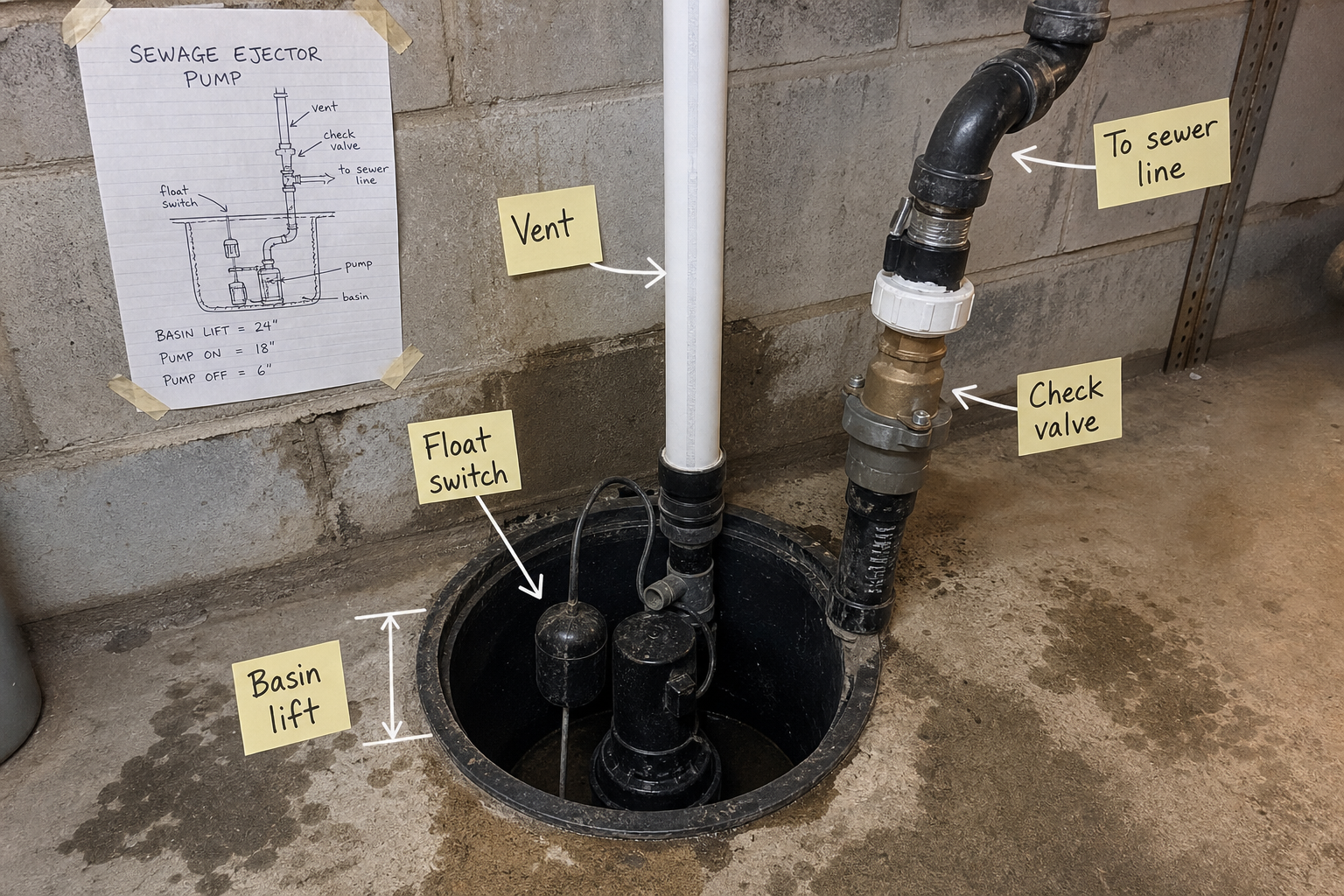
Field-style article image prepared for what is sewage ejector pump.
When a sewage ejector pump cycles every twelve minutes instead of the expected thirty-minute interval, the first diagnostic check targets basin volume and inflow rate. A sewage ejector pump is a submersible or pedestal pump that lifts raw sewage and solids from a below-grade collection basin to an elevated gravity sewer line or septic tank. The system combines a sealed basin, a solids-handling pump, a check valve to prevent backflow, and code-required venting to manage sewer gas.
Unlike a sump pump that handles clear groundwater, a sewage ejector pump must pass solids up to two inches in diameter and manage the corrosive, gas-producing environment of raw wastewater. The pump discharges through a check valve into a pressurized riser that climbs to meet the main drain line, typically 10 to 25 feet above the basin floor.
Key Takeaways
- A sewage ejector pump lifts raw sewage from below-grade fixtures to an above-grade sewer line when gravity drainage is not possible.
- The basin must provide 30 to 70 gallons of working volume between pump-on and pump-off levels to prevent short-cycling and motor overheating.
- A check valve on the discharge riser prevents backflow of sewage into the basin when the pump stops; valve failure causes immediate re-filling and nuisance alarms.
- Venting the basin to atmosphere or into the building drain-waste-vent system is required by plumbing codes to relieve sewer gas and prevent air lock during pump operation.
- Residential systems handle 1.5- to 2-inch solids at flows of 20 to 50 GPM; commercial or multi-family systems may require duplex pumps and larger basins to manage higher peak flows.
Basin and Pit Design Requirements
The ejector basin is a watertight pit, typically 18 to 30 inches in diameter and 30 to 48 inches deep, made from polyethylene, fiberglass, or concrete. Basin volume between the pump start level and the inflow inlet controls pump run time and cycle frequency.
A minimum working volume of 30 gallons allows the pump to run for at least two minutes per cycle, which protects the motor from thermal damage caused by frequent starts. For a pump rated at 20 GPM, a 30-gallon working volume yields a three-minute run time, satisfying the minimum duty cycle for most residential motors.
Basin sizing follows this relationship:
**Working Volume (gallons) = Pump Flow Rate (GPM) × Minimum Run Time (minutes)**
Where minimum run time is typically 2 to 3 minutes for residential pumps and 5 to 10 minutes for commercial duplex systems.
The pump sits on a pedestal or concrete pad at the basin floor, with the inlet positioned 6 to 12 inches above the bottom to create a sump that traps heavy solids and grit. A float switch or pressure transducer mounted inside the basin controls pump start and stop levels. High-water alarms activate when the water rises 3 to 6 inches above the normal pump-on level, signaling pump failure or excessive inflow.
Check Valve and Discharge Piping Function
The discharge riser carries sewage from the pump outlet vertically to the gravity drain connection point. A swing check valve or spring-loaded check valve installed 12 to 24 inches above the basin floor prevents the discharge column from draining back into the basin after the pump stops.
Check valve failure is the most common cause of nuisance cycling. When the valve seat erodes or the flapper binds open, the discharge column—often 10 to 20 feet of 2- or 3-inch pipe holding 2 to 5 gallons—drains back into the basin within seconds of pump shutoff. This immediate re-fill triggers the float switch, restarting the pump before the motor has cooled.
The discharge pipe must slope upward at a minimum of 1/4 inch per foot to prevent air pockets and ensure full pipe flow. A union or flanged connection below the check valve allows pump removal without draining the entire riser. The riser material is typically schedule 40 PVC for residential systems and ductile iron or schedule 80 PVC for commercial installations where mechanical damage risk is higher.
Venting Requirements and Code Compliance
Sewage ejector basins generate methane, hydrogen sulfide, and other sewer gases that must be vented to prevent explosive accumulation and pressure imbalance during pump operation. The International Plumbing Code and Uniform Plumbing Code both require venting the basin to atmosphere or connecting it to the building drain-waste-vent system.
A 2-inch vent line connects to the basin lid and runs vertically to the roof or ties into an existing vent stack at least 6 inches above the flood-level rim of the highest fixture served. The vent prevents air lock when the pump starts and allows atmospheric pressure to equalize as sewage enters the basin.
Unvented or undersized vents create negative pressure during pump operation, reducing flow rate and increasing motor load. In extreme cases, the vacuum can collapse flexible discharge tubing or prevent the pump from priming. Vent sizing follows the same diameter rules as gravity drain vents: minimum 2 inches for residential ejector basins and 3 to 4 inches for commercial systems handling higher flow rates.
Use Cases and Application Boundaries
Sewage ejector pumps solve below-grade drainage problems in three common scenarios:
**Basement bathrooms and laundry rooms** where fixtures drain below the main sewer line require an ejector basin to lift wastewater 8 to 15 feet to reach the building drain. A typical residential system uses a 1/2 to 3/4 HP pump rated for 20 to 40 GPM at 15 feet of head.
**Septic system dosing** in rural installations where the septic tank sits uphill from the house uses an ejector pump to lift sewage from a collection basin to the tank inlet. These systems often include timer controls to dose the septic field at regular intervals rather than on demand.
**Multi-family and commercial buildings** with below-grade tenant spaces install duplex ejector systems with two pumps alternating lead duty. The standby pump provides redundancy if the lead pump fails, and the basin includes high-level alarms connected to building management systems.
Sewage ejector pumps are not suitable for lift stations handling combined sewage and stormwater, where centrifugal pumps with larger impeller passages and higher flow capacity are required. They also differ from grinder pumps, which macerate solids before discharge and can pump through smaller-diameter force mains over longer distances.
Pump Selection and Sizing Criteria
Selecting a sewage ejector pump requires four inputs: total dynamic head, peak flow rate, solids-passing capability, and duty cycle. Total dynamic head is the vertical lift from the basin floor to the discharge point plus friction losses in the piping system. For residential systems with 15 feet of lift and 20 feet of horizontal piping, total head typically ranges from 18 to 22 feet.
Peak flow rate equals the sum of fixture unit discharge rates that can operate simultaneously. A full bathroom (toilet, sink, shower) generates approximately 20 to 25 GPM during peak use. The pump must handle this flow without allowing the basin level to rise above the high-water alarm point.
Solids-passing capability is defined by the largest spherical solid the pump can pass without clogging. Residential sewage ejector pumps pass 1.5- to 2-inch solids; commercial pumps for public restrooms may pass 3-inch solids. The pump impeller type—semi-open, enclosed, or vortex—determines solids-handling performance and maintenance frequency.
Duty cycle limits protect the motor from overheating. Most residential sewage ejector pumps are rated for 30 to 50 starts per hour. Exceeding this limit requires either a larger basin to reduce cycle frequency or a pump with a higher thermal capacity motor.
FAQs
Can a sewage ejector pump replace a grinder pump?
A sewage ejector pump passes solids intact and requires a minimum 2-inch discharge pipe. A grinder pump macerates solids and can discharge through 1.25- to 2-inch force mains over distances exceeding 1,000 feet. Use a grinder pump when the discharge distance or pipe size restriction makes a standard ejector pump impractical.
What causes a sewage ejector pump to run continuously?
Continuous running indicates either a failed check valve allowing discharge backflow, a stuck float switch holding the pump in the on position, or inflow rate exceeding pump capacity. Check the check valve first by listening for water flowing back into the basin after the pump stops.
How often should the basin be cleaned?
Inspect and clean the basin every 6 to 12 months to remove grit, grease buildup, and debris that can foul the float switch or pump inlet. Commercial systems in high-use environments may require quarterly maintenance. Pump manufacturers specify cleaning intervals based on application type and solids load.
Is a sewage ejector pump the same as a sump pump?
No. A sump pump handles clear groundwater and is not designed for solids or corrosive sewage. A sewage ejector pump uses chemical-resistant seals, a solids-handling impeller, and materials rated for continuous immersion in raw wastewater. Installing a sump pump in a sewage application causes rapid seal failure and motor damage.
Conclusion
A properly sized sewage ejector pump system depends on matching basin working volume to pump flow rate, ensuring check valve integrity, and providing code-compliant venting to prevent gas accumulation and pressure imbalance. Before specifying a system, confirm total dynamic head from the basin floor to the discharge connection point, calculate peak flow from simultaneous fixture use, and verify that the pump can handle the required solids size without frequent clogging. For below-grade commercial installations, specify duplex pumps with alternating lead control and high-level alarms to maintain service continuity during maintenance or component failure.